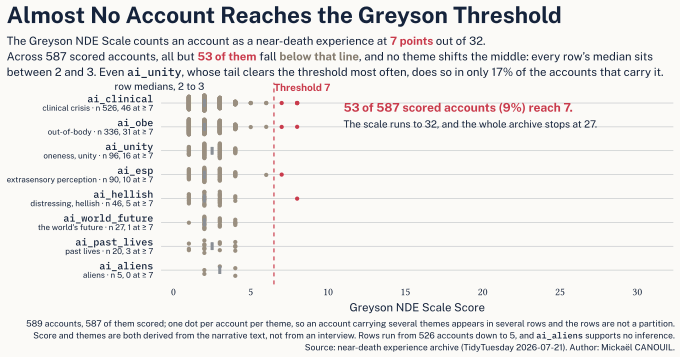
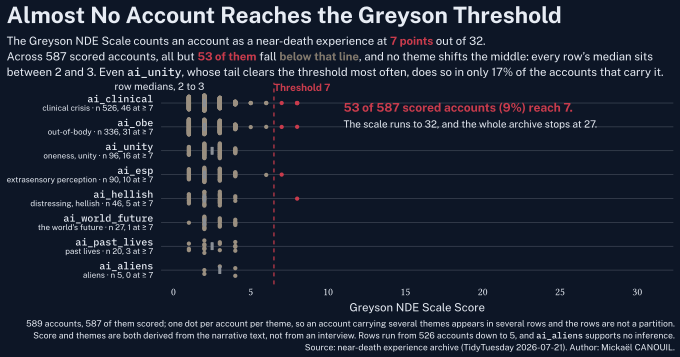
// Gribouille comes from the typst-render preamble (assets/typst/_preamble.typ),
// so this file does not import it.

// One row per account in the near-death experience archive. The Greyson score and
// the eight theme flags come from the narrative text rather than from an
// interview, which is the caveat in the caption. Every number in the chart is
// computed from this table.
// Source: data/nde_experiences.csv (TidyTuesday 2026-07-21).
#let raw = csv("data/nde_experiences.csv", row-type: dictionary)

// Scores are written as whole numbers, with "NA" where none was assigned.
#let score-of(v) = if v == none or v == "" or v == "NA" { none } else { int(v) }
#let pct = format-percent()

// The Greyson NDE Scale runs 0 to 32 and treats 7 as the threshold for a
// near-death experience. The chart is built around that number.
#let threshold = 7
#let scale-max = 32

// Every account carrying a score: the denominator behind the headline share.
#let scored = raw.map(r => score-of(r.greyson_score)).filter(s => s != none)
#let n-accounts = raw.len()
#let n-scored = scored.len()
#let n-above = scored.filter(s => s >= threshold).len()
#let pct-above = pct(n-above / n-scored)
#let overall-median = median(scored).y
#let archive-max = calc.max(..scored)

// One pass per theme, collecting the scores of the accounts that carry it. An
// account can carry several themes, so it appears in several rows. Commonest
// first: the panel is built upright and flipped, so slot 1 lands at the bottom.
//
// The eight coded themes, each with the gloss the axis carries beside its column
// name. This order is the source order. The rows sort by how many accounts carry
// each theme.
#let rows = (
  (col: "ai_clinical", gloss: "clinical crisis"),
  (col: "ai_obe", gloss: "out-of-body"),
  (col: "ai_unity", gloss: "oneness, unity"),
  (col: "ai_esp", gloss: "extrasensory perception"),
  (col: "ai_hellish", gloss: "distressing, hellish"),
  (col: "ai_world_future", gloss: "the world's future"),
  (col: "ai_past_lives", gloss: "past lives"),
  (col: "ai_aliens", gloss: "aliens"),
).map(spec => {
  let s = raw
    .filter(r => r.at(spec.col) == "TRUE")
    .map(r => score-of(r.greyson_score))
    .filter(v => v != none)
  spec + (
    n: s.len(),
    median: median(s).y,
    above: s.filter(v => v >= threshold).len(),
    scores: s,
  )
}).sorted(key: t => t.n).rev()
#let n-rows = rows.len()
#let slot-of(i) = n-rows - i

// The row whose tail clears the threshold most often, found by share, and the
// row too small to say anything about. Rows under twenty accounts are left out
// of the first search.
#let stretch = rows.filter(t => t.n >= 20).sorted(key: t => t.above / t.n).last()
#let stretch-pct = pct(stretch.above / stretch.n)
#let biggest = rows.first()
#let thinnest = rows.last()

#let bands = ("below", "at or above")

// The subtitle claims no theme shifts the middle, so a median crossing the
// threshold fails the render.
#let medians = rows.map(t => t.median)
#let median-lo = calc.min(..medians)
#let median-hi = calc.max(..medians)
#assert(
  median-hi < threshold,
  message: "a theme's median now reaches the threshold: " + repr(medians),
)

// The crimson is reserved for accounts that clear the threshold. Everything below
// is a backdrop rather than a second category, so the neutral reads as grey. The
// rule and the per-row counts repeat the split, so identity never rests on
// colour. Both clear the checks on both surfaces.
#let above-col = rgb("#c93b4c") // crimson: reaches the diagnostic threshold
#let below-col = rgb("#9a8f80") // warm neutral: the rest of the archive

// A public-record sans for the prose, and a data face for the column names,
// because the row labels are columns of the dataset. Both are vendored in
// assets/fonts, so CI renders them too.
#let body-font = "Public Sans"
#let mono-font = "IBM Plex Mono"

// No fill means "say nothing about the colour", so the text takes the page ink
// whichever way the site is toggled. A colour is passed only for text naming a
// coloured mark.
#let note(body, fill: none, size: 7pt, weight: "regular") = {
  set text(fill: fill) if fill != none
  text(font: body-font, size: size, weight: weight)[#body]
}
#let col-name(name, size) = text(font: mono-font, size: size, weight: "medium")[#name]

#let swarm-width = 0.32

#plot(
  // One point per account per theme it carries. Colour encodes one thing:
  // whether the account reaches the threshold.
  data: rows.enumerate().map(((i, t)) => t.scores.map(s => (
    slot: slot-of(i),
    score: s,
    band: if s >= threshold { bands.last() } else { bands.first() },
  ))).join(),
  mapping: aes(x: "slot", y: "score", fill: "band", alpha: "band"),
  layers: (
    // The threshold: the line almost nothing crosses. Drawn half a point below 7,
    // so it separates the integer scores.
    geom-hline(
      yintercept: threshold - 0.5,
      stroke: 0.9pt, colour: above-col, linetype: "dashed", inherit-aes: false,
    ),
    // One dot per account, swarmed so the thickness of a row shows where the
    // scores pile up. Small and translucent, since dense rows stack hundreds.
    geom-beeswarm(
      size: 1.6pt, stroke: 0pt,
      position: position-beeswarm(width: swarm-width),
    ),
    // Each row's median, as a rule across its own swarm, in a neutral that
    // reads as a mark rather than a category. Sized in data units off the swarm
    // width, so it tracks the rows.
    geom-errorbarh(
      data: rows.enumerate().map(((i, t)) => (slot: slot-of(i), median: t.median)),
      mapping: aes(x: "slot", xmin: "median", xmax: "median"),
      inherit-aes: false, height: swarm-width, stroke: 2pt, colour: rgb("#8a8f96"),
    ),
    // Both rules are labelled in the empty band above the top row, so the panel
    // needs no legend.
    annotate(
      "typst", x: n-rows + 0.5, y: threshold - 0.5,
      label: note(fill: above-col, size: 7.5pt, weight: "bold")[Threshold #threshold],
      anchor: "south-west", clip: false,
    ),
    annotate(
      "typst", x: n-rows + 0.5, y: overall-median,
      label: note(size: 7.5pt)[row medians, #median-lo to #median-hi],
      anchor: "south-east", clip: false,
    ),
    // One callout in the empty tail, where the scores the scale was built for
    // would sit.
    annotate(
      "typst", x: n-rows, y: 11,
      label: box(width: 8.4cm)[
        #note(fill: above-col, size: 9pt, weight: "bold")[
          #n-above of #n-scored scored accounts (#pct-above) reach #threshold.
        ] \
        #note(size: 7.5pt)[
          The scale runs to #scale-max, and the whole archive stops at
          #archive-max.
        ]
      ],
      anchor: "north-west", clip: false,
    ),
  ),
  scales: scales(
    x: scale-continuous(
      breaks: range(n-rows).map(slot-of),
      // Two-line tick label: the column name as it appears in the data, then the
      // gloss, the number of accounts, and how many reach the threshold. Those
      // counts do the work of a legend.
      labels: rows.map(t => box(inset: (right: 3pt))[
        #set align(right)
        #set par(leading: 2pt)
        #col-name(t.col, 7.5pt) \
        #note(size: 6pt)[#t.gloss · n #t.n, #t.above at #sym.gt.eq #threshold]
      ]),
      limits: (0.4, n-rows + 0.85),
      expand: (0%, 0%),
    ),
    y: scale-continuous(
      breaks: (0, 5, 10, 15, 20, 25, 30),
      limits: (-0.8, scale-max),
      expand: (0%, 1%),
    ),
    fill: scale-manual(values: (below-col, above-col), limits: bands),
    // The accounts that clear the threshold are the point, so they run at full
    // strength while the bulk recedes.
    alpha: scale-manual(values: (0.6, 1), limits: bands),
  ),
  coord: coord-flip(),
  guides: guides(default: none),
  labels: labels(
    title: "Almost No Account Reaches the Greyson Threshold",
    // Under coord-flip the scale keys stay pre-flip, so `x` is the row axis and
    // `y` is the score axis.
    x: none,
    y: "Greyson NDE Scale Score",
    subtitle: [
      The Greyson NDE Scale counts an account as a near-death experience at
      #text(fill: above-col, weight: "bold")[#threshold points] out of #scale-max. \
      Across #n-scored scored accounts, all
      but #text(fill: above-col, weight: "bold")[#n-above of them] fall
      #text(fill: below-col.darken(15%), weight: "bold")[below that line], and
      no theme shifts the middle: every row's median sits between
      #median-lo and #median-hi.
      Even #col-name(stretch.col, 8.5pt), whose
      tail clears the threshold most often, does so in only #stretch-pct of the
      accounts that carry it.
    ],
    caption: typst([
      #n-accounts accounts, #n-scored of them scored; one dot per account per theme, so an account carrying several themes appears in several rows and the rows are not a partition. \
      Score and themes are both derived from the narrative text, not from an interview. Rows run from #biggest.n accounts down to #thinnest.n, and #col-name(thinnest.col, 6.5pt) supports no inference. \
      Source: near-death experience archive (TidyTuesday 2026-07-21). Author: #link("https://mickael.canouil.fr")[Mickaël CANOUIL].
    ]),
  ),
  theme: theme-minimal(
    plot-title: element-text(font: body-font, size: 17pt, weight: "bold"),
    plot-subtitle: element-text(font: body-font, size: 8.5pt),
    plot-caption: element-text(font: body-font, size: 6.5pt),
    axis-title: element-text(font: body-font, size: 8.5pt),
    axis-text-y: element-text(font: mono-font, size: 7.5pt),
    panel-grid-major-x: element-blank(),
    panel-grid-minor: element-blank(),
  ),
  width: auto,
  height: auto,
)