geom-typst
Text label layer whose label aesthetic is always evaluated as Typst markup.
Sibling of geom-text. Use this when every label string must be interpreted as Typst markup at the call site, without wrapping each column reference in typst.
Usage
geom-typst(
  mapping: none,
  data: none,
  size: 10pt,
  colour: auto,
  font: auto,
  alpha: auto,
  anchor: "center",
  angle: 0deg,
  label: none,
  segment: false,
  segment-colour: auto,
  segment-stroke: 0.4pt,
  min-segment-length: 0.05,
  arrow: none,
  box-padding: 0.05,
  repel: false,
  point-padding: 0.05,
  max-iter: 100,
  force-pull: 0.1,
  force-push: 0.2,
  force-segment: 0.3,
  seed: 0,
  stat: "identity",
  position: "identity",
  key: auto,
  inherit-aes: true,
)
Parameters
| Parameter | Default | Description |
|---|---|---|
mapping |
none |
Layer-specific aesthetic mapping built with aes. Must map x and y. Map label to a column when each row carries its own label, or pass label: directly to use a single constant value for every row. |
data |
none |
Layer-specific dataset, or a function applied to the plot data returning the layer frame. Falls back to the plot data when none. |
size |
10pt |
Text size (a Typst length). |
colour |
auto |
Fixed text colour. auto inherits the theme ink. Used when no colour mapping is active. |
font |
auto |
Label font family. auto uses the theme text font, then the document font. |
alpha |
auto |
Text opacity in [0, 1]. auto honours any mapped alpha aesthetic. |
anchor |
"center" |
CeTZ anchor (e.g., "center", "west") controlling placement. |
angle |
0deg |
Rotation applied to each label (a Typst angle, e.g., 45deg). Positive angles rotate anticlockwise about the anchor. |
label |
none |
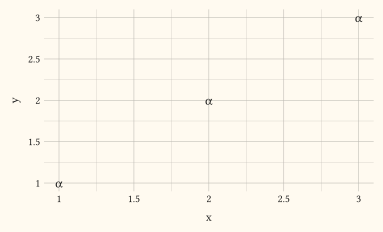
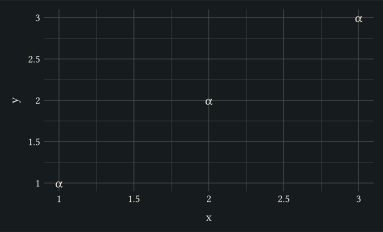
Constant label drawn at every row’s (x, y). Accepts a Typst content block ([#math.alpha], [*bold*]) or a markup string ("$alpha$") eval’d as Typst at render time. When none, the label is read from the label aesthetic mapping. |
segment |
false |
Draw a connector from each label back to its anchor point. When true, the connector is routed to avoid the AABBs of other labels of the same layer; dropped when no L-bend clears the obstacles. |
segment-colour |
auto |
Connector paint. auto inherits the theme ink. |
segment-stroke |
0.4pt |
Connector thickness (a Typst length). |
min-segment-length |
0.05 |
Connectors shorter than this distance (canvas units, 1 = 1cm) are suppressed. |
arrow |
none |
Arrowhead spec built with arrow, drawn on the connector. ends: "last" (the default) marks the anchor end, ends: "first" the label end. none draws a plain connector. |
box-padding |
0.05 |
Extra cm padding around each measured label when routing connectors. |
repel |
false |
Repel labels off each other (and off their anchor points) via an iterative force-based layout, ggrepel-style. Pair with segment: true to keep the visual link to each anchor. |
point-padding |
0.05 |
Minimum clearance (cm) between a label and any anchor point when repel is on. |
max-iter |
100 |
Maximum number of repulsion iterations. |
force-pull |
0.1 |
Strength of the spring pull that keeps each label near its anchor. |
force-push |
0.2 |
Strength of the repulsion between overlapping labels. |
force-segment |
0.3 |
Strength of the penalty that pushes a label off another label’s connector path. |
seed |
0 |
Random seed for the small initial jitter applied to coincident anchors. |
stat |
"identity" |
Statistical transform name. Usually "identity". |
position |
"identity" |
Position adjustment name. Usually "identity". |
key |
auto |
Legend glyph override built with a draw-key-* helper. auto picks the default for the geom. |
inherit-aes |
true |
Whether to merge the plot-level mapping into this layer’s mapping. |
Returns
Layer dictionary consumed by plot.
Examples
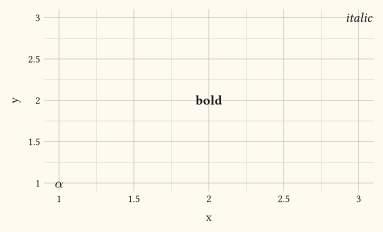
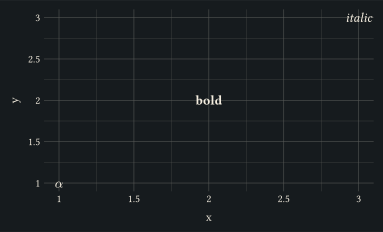
Each row’s label column carries Typst markup that is evaluated in place; no typst() wrapper is needed at the call site.
#let d = (
  (x: 1, y: 1, t: "$alpha$"),
  (x: 2, y: 2, t: "*bold*"),
  (x: 3, y: 3, t: "#emph[italic]"),
)
#plot(
  data: d,
  mapping: aes(x: "x", y: "y", label: "t"),
  layers: (geom-typst(),),
  width: 10cm,
  height: 6cm,
)
Use a constant content block as the label at every row.
#let d = (
  (x: 1, y: 1),
  (x: 2, y: 2),
  (x: 3, y: 3),
)
#plot(
  data: d,
  mapping: aes(x: "x", y: "y"),
  layers: (geom-typst(label: [#math.alpha]),),
  width: 10cm,
  height: 6cm,
)