Report an estimate with its error
Two columns read as one, because that is how a reader reads them.
An estimate and its standard error are one number to a reader, and so are the two bounds of an interval. columns-combine builds one column from several, through a pattern that takes one argument per source.
// One column built from several. The pattern reads the formatted content of its
// sources, which is why the estimate keeps two decimals and the error three:
// each source was formatted by its own directive before the pattern saw it.
//
// The labels are centred with `column-labels-align`. The stubhead and the
// column labels both follow it.

#import "@preview/keisen:0.0.1": *

#set page(width: auto, height: auto, margin: 0.5cm)
#set text(font: "Libertinus Serif", size: 10pt)

#display-table(
  (
    gene: ("BRCA1", "TP53", "PTEN", "APC"),
    estimate: (1.234, -0.567, 0.089, 2.401),
    error: (0.021, 0.043, 0.112, 0.008),
    lower: (1.193, -0.651, -0.130, 2.385),
    upper: (1.275, -0.483, 0.308, 2.417),
    p: (0.0000012, 0.031, 0.42, 0.0000000004),
  ),
  table-header(title: [Association results], subtitle: [Effect per copy of the minor allele]),
  table-stub(rowname: "gene", label: [Gene]),
  format-number("estimate", decimals: 2),
  format-number("error", decimals: 3),
  format-number(("lower", "upper"), decimals: 2),
  format-scientific("p", decimals: 1),
  columns-combine(
    "effect",
    ("estimate", "error"),
    (value, margin) => [#value #h(0.2em) (#margin)],
    label: [Effect (SE)],
  ),
  columns-combine(
    "interval",
    ("lower", "upper"),
    (low, high) => [#low #sym.dash.en #high],
    label: [95% CI],
  ),
  columns-label(p: [_p_]),
  // A combined column holds content, not numbers, so no alignment is inferred
  // for it. This puts it against the end edge.
  columns-align(end, columns: "effect"),
  table-options(column-labels-align: center),
  table-source-note([Source: association study.]),
  theme: theme-booktabs(),
)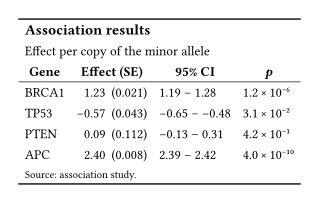
The estimate keeps two decimals and the error three, because the pattern receives the formatted content of its sources rather than their raw values. That is why combine sits after format in the pipeline.
It is also the price. A combined column carries content, so it is opaque afterwards: aligned to the start unless columns-align says otherwise, not lined up on a decimal separator, and outside any summary. That is why the effect column names itself in columns-align above.
A label follows its own column by default, so these labels would not share one edge. column-labels-align centres every one of them instead, the stubhead included, and leaves the cells where their columns put them.