Write values in their own notation
Money, magnitudes, sizes, dates, and markup.
A price is not a number with a symbol stuck on it, and neither is a payload size. Each formatter writes the value the way its notation is read, and the first three fill a slot the alignment stage reserves, so the columns line up on what matters: prices under their symbols, exponents under their multiplication signs, units under units.
// Currency, scientific notation, and byte sizes, each filling a slot the
// alignment stage reserves. The columns are the point: prices line up under
// their symbols, exponents under one another, and units under units, none of
// which happens unless every slot is padded to the column's widest.

#import "@preview/keisen:0.0.1": *

#set page(width: auto, height: auto, margin: 0.5cm)
#set text(font: "Libertinus Serif", size: 10pt)

#display-table(
  (
    component: ("Sensor", "Controller", "Housing", "Cabling"),
    price: (1250.5, 89.99, 12500, 7.5),
    charge: (0.0000000016, 1.6e-19, 250000, 9990),
    firmware: (512, 2048, 1073741824, 1536000),
  ),
  table-header(title: [Bill of materials], subtitle: [Unit costs and payload sizes]),
  table-stub(rowname: "component", label: [Component]),
  columns-label(price: [Price], charge: [Charge], firmware: [Firmware]),
  format-currency("price", currency: "EUR"),
  format-scientific("charge", decimals: 2),
  format-bytes("firmware"),
  table-source-note([Source: supplier quotations.]),
  theme: theme-booktabs(),
)

#v(1em)

The same figures with the symbol trailing, the exponent written as an e, and
sizes counted in thousands rather than in 1024s.

#display-table(
  (
    component: ("Sensor", "Controller", "Housing", "Cabling"),
    price: (1250.5, 89.99, 12500, 7.5),
    charge: (0.0000000016, 1.6e-19, 250000, 9990),
    firmware: (512, 2048, 1073741824, 1536000),
  ),
  table-stub(rowname: "component", label: [Component]),
  columns-label(price: [Price], charge: [Charge], firmware: [Firmware]),
  format-currency("price", currency: "JPY", position: end),
  format-scientific("charge", exponent: "e"),
  format-bytes("firmware", base: 1000),
  theme: theme-booktabs(),
)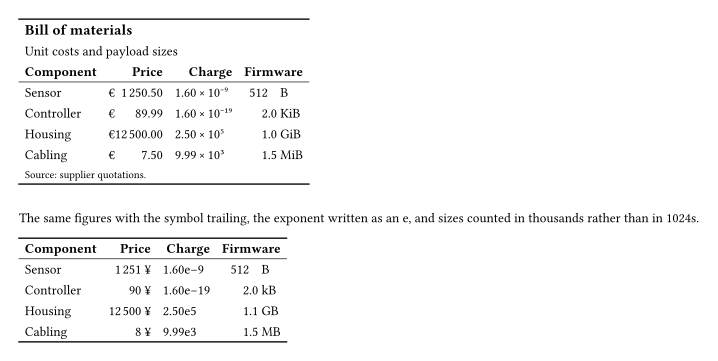
The second table is the same figures said differently: position: end for the currencies written that way, exponent: "e" for output rather than typesetting, and base: 1000 for the people who sell disks. A yen figure carries no decimals, because the currency has no minor unit and two places would invent a precision it does not circulate in.
Dates and markup
Neither produces alignment slots: a date has no separator to line up on, and a cell of markup is whatever it evaluates to, so both follow the column alignment like any other text.
// Dates and markup, the two formatters that produce opaque content rather than
// alignment slots: there is no decimal point in either, so both follow the
// column alignment like any other text.

#import "@preview/keisen:0.0.1": *

#set page(width: auto, height: auto, margin: 0.5cm)
#set text(font: "Libertinus Serif", size: 10pt)

#display-table(
  (
    release: ("0.1.0", "0.2.0", "0.3.0"),
    // Both spellings of an ISO instant, and a datetime the document built.
    published: ("2026-03-01", "2026-06-17T09:30:00", datetime(year: 2026, month: 8, day: 14)),
    // Typst markup carried as text, which is how a generator emits emphasis.
    summary: (
      "First release, *unstable*.",
      "Adds `format-currency` and friends.",
      "_Nanoplots_ drawn natively.",
    ),
  ),
  table-header(title: [Release history]),
  table-stub(rowname: "release", label: [Version]),
  columns-label(published: [Published], summary: [Summary]),
  format-date("published", pattern: "[day] [month repr:long] [year]"),
  format-markup("summary"),
  table-source-note([Source: the changelog.]),
  theme: theme-booktabs(),
)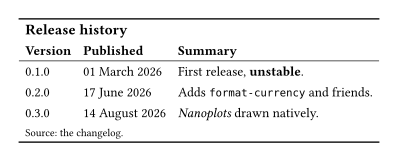
The three dates were written three different ways in the data: an ISO date, an ISO timestamp, and a datetime the document built. The summaries are Typst markup carried as text, which is what a generator emits when a cell has emphasis it cannot express as content.