Write numbers the local way
One theme setting, and every numeric column follows it.
A French table writes a comma where an English one writes a point. That convention belongs to the document, not to each directive, so it is set once on the theme: every numeric column reads number-group-separator and number-decimal-separator, whichever formatter it goes through.
// A table written the French way, and an unbounded value.
//
// The separators are set once on the theme rather than on each directive: every
// numeric column below, whichever formatter it goes through, reads
// number-group-separator and number-decimal-separator. Look for a comma in the
// price, the ratio and the mantissa alike, a non-breaking space grouping the
// thousands, and the infinity sitting in the column without disturbing the
// decimal alignment of the numbers above it.

#import "@preview/keisen:0.0.1": *

#set page(width: auto, height: auto, margin: 0.5cm)
#set text(font: "Libertinus Serif", size: 10pt)

#display-table(
  (
    poste: ("Matériel", "Licences", "Transport", "Divers"),
    montant: (12500.5, 3400.75, 289.9, 42.0),
    ratio: (1.5, 2.25, float.inf, 0.75),
    charge: (0.0000000016, 250000, 9990, 1.6),
  ),
  table-header(title: [Dépenses], subtitle: [Exercice 2026]),
  table-stub(rowname: "poste", label: [Poste]),
  columns-label(montant: [Montant], ratio: [Ratio], charge: [Charge]),
  format-currency("montant", currency: "EUR", position: end),
  format-number("ratio", decimals: 2, infinity: [∞]),
  format-scientific("charge", decimals: 2),
  table-options(
    number-group-separator: sym.space.nobreak,
    number-decimal-separator: ",",
  ),
  theme: theme-booktabs(),
)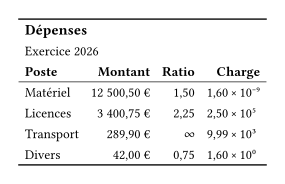
The comma appears in the price, the ratio and the mantissa, because all three formatters left their separators at auto and auto means the theme’s. An argument written on a directive still wins, so one column can depart from the convention without disturbing the rest.
The infinity is the other thing to look at. Only finite numbers are formatted, so an unbounded value is an error unless infinity: says what to write for one. What it writes is opaque content, which is why it sits in the column without disturbing the decimal alignment of the numbers above it, and why a column holding one cannot be summarised.