Mark a cell that fails a threshold
Highlighted because of its value, not because of its position.
A margin below five per cent should stand out wherever it lands. cells-body takes a row predicate, so the rule is written as the condition itself rather than as the coordinates of whichever cell happens to meet it today.
This is the thing show rules cannot do: they select by element type in document order and never see the row behind a cell.
// Conditional styling, data-driven colour, substitutions, and footnote marks
// numbered in reading order.

#import "@preview/keisen:0.0.1": *

#set page(width: auto, height: auto, margin: 0.5cm)
#set text(font: "Libertinus Serif", size: 10pt)

#display-table(
  (
    product: ("Bolt", "Nut", "Beam", "Plate"),
    region: ("North", "North", "South", "South"),
    units: (1250, 860, 430, 2100),
    margin: (0.182, 0.031, 0.094, none),
  ),
  table-header(title: [Regional sales], subtitle: [Financial year 2025 to 2026]),
  table-stub(rowname: "product", group: "region", label: [Product]),
  columns-label(units: [Units], margin: [Margin]),
  table-spanner([Performance], ("units", "margin")),
  format-integer("units"),
  format-percent("margin", decimals: 1),
  substitute-missing("margin", replacement: [--]),
  data-colour(("#f7fbff", "#08519c"), columns: "units"),
  table-style(
    style(text: (fill: rgb("#b2182b"), weight: "bold")),
    locations: cells-body(columns: "margin", rows: row => row.margin != none and row.margin < 0.05),
  ),
  table-footnote([Excludes intra-group sales.], locations: cells-column-labels(columns: "units")),
  table-footnote([Margin was not reported.], locations: cells-body(columns: "margin", rows: 3)),
  table-source-note([Source: internal ledger.]),
)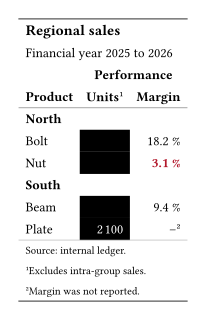
The predicate tests row.margin != none before comparing it, because one product reported no margin at all and a comparison against nothing would fail rather than be false.
Three things then happened without being asked for. The dark blue fills carry white text, chosen per cell from the background’s relative luminance. The missing margin was replaced before it reached the formatter, which would otherwise have refused it. The marks are numbered in the order a reader meets them, so the column label takes 1 and the body cell takes 2, whichever order they were written in.
Back to top