mpg
Fuel economy of 30 cars (small fuel-economy reference dataset).
Each row is one vehicle. Columns:
manufacturer(string).model(string).displ(engine displacement, litres).cyl(number of cylinders).drv(drive train:"4"four-wheel,"f"front-wheel,"r"rear-wheel).class(vehicle class, e.g.,"compact","midsize","suv").cty(city miles per gallon).hwy(highway miles per gallon).
The bundled literal is stored in column-store form; plot accepts either column-store or row-store input and normalises internally.
Source: subset of the mpg dataset bundled with the ggplot2 R package; see help("mpg") in R. Originally extracted from the US Environmental Protection Agency’s fuel economy data, https://fueleconomy.gov/, restricted to models with a new release every year between 1999 and 2008.
Usage
mpgExamples
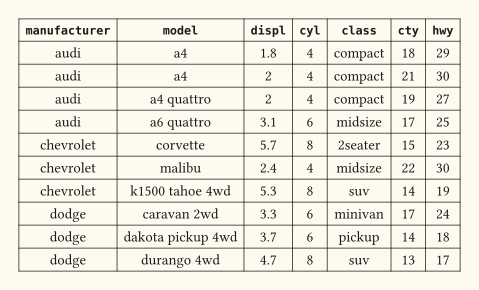
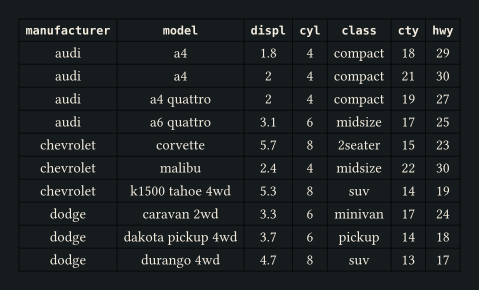
Preview the first ten entries (out of 30).
#let rows = mpg.slice(0, 10)
#let keys = rows.first().keys()
#let cell(v) = if v == none { text(fill: gray, [_none_]) } else { [#v] }
#table(
  columns: keys.len(),
  align: center + horizon,
  inset: 5pt,
  stroke: 0.5pt,
  ..keys.map(k => strong(raw(k))),
  ..rows.map(r => keys.map(k => cell(r.at(k)))).flatten(),
)
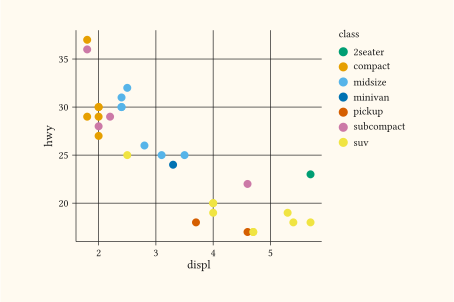
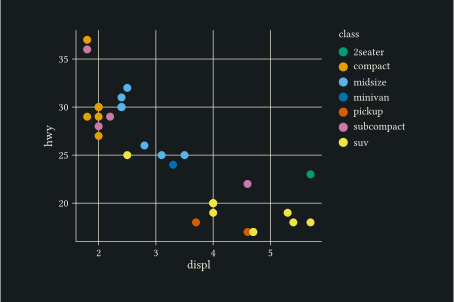
Highway mpg vs engine displacement, filled by vehicle class.
#plot(
  data: mpg,
  mapping: aes(x: "displ", y: "hwy", fill: "class"),
  layers: (geom-point(size: 3pt),),
  width: 11cm,
  height: 7cm,
)
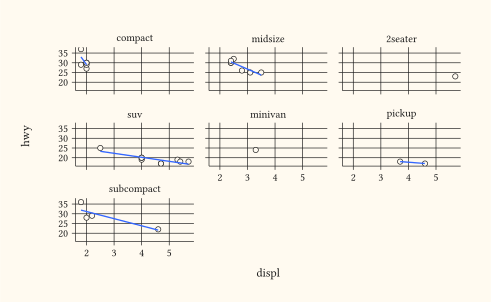
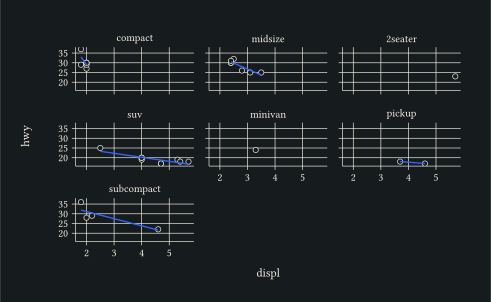
Facet by class and add a linear smoother per panel to compare per-class trends.
#plot(
  data: mpg,
  mapping: aes(x: "displ", y: "hwy"),
  layers: (
    geom-point(size: 2pt),
    geom-smooth(method: "lm", se: false),
  ),
  facet: facet-wrap("class", ncolumn: 3),
  width: 12cm,
  height: 7cm,
)