coord-flip
Cartesian coordinate system with the x and y axes swapped at render time.
Use this to turn a vertical bar chart into a horizontal one without rewriting the data or the mapping. The axis labels, ticks, and the directional geoms (geom-col, geom-hline, geom-vline, geom-abline) follow the swap automatically. Direction-agnostic geoms (geom-point, geom-line, geom-path, geom-step, geom-segment) work via the same swap with no per-geom changes.
default) reverses only when the post-flip y axis is discrete so the first level sits at the top. true always reverses; false keeps the bottom-to-top direction.
Usage
coord-flip(
  reverse: auto,
)
Parameters
| Parameter | Default | Description |
|---|---|---|
reverse |
auto |
Whether to reverse the post-flip y axis. auto (the |
Returns
Coordinate dictionary consumed by plot.
Examples
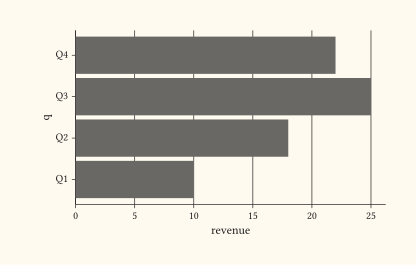
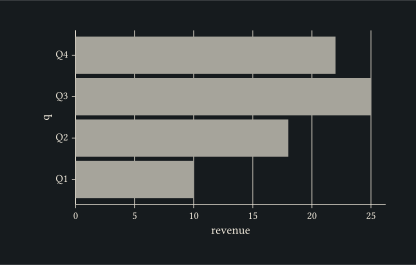
Flip a vertical bar chart into a horizontal one without rewriting the mapping.
#let d = (
  (q: "Q1", revenue: 10),
  (q: "Q2", revenue: 18),
  (q: "Q3", revenue: 25),
  (q: "Q4", revenue: 22),
)
#plot(
  data: d,
  mapping: aes(x: "q", y: "revenue"),
  layers: (geom-col(),),
  coord: coord-flip(),
  width: 10cm,
  height: 6cm,
)
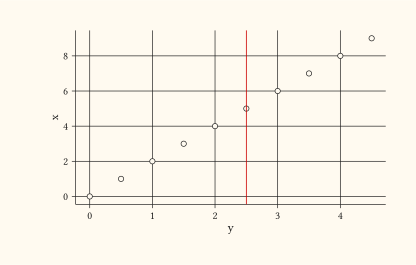
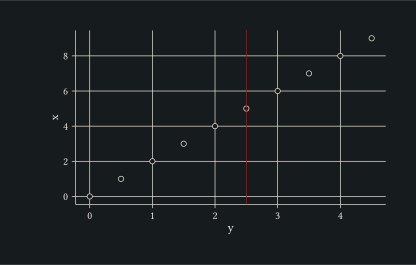
Reference lines follow the flip: a yintercept becomes a vertical reference once the axes swap.
#let d = range(0, 10).map(i => (x: i, y: i * 0.5))
#plot(
  data: d,
  mapping: aes(x: "x", y: "y"),
  layers: (
    geom-point(size: 2pt),
    geom-hline(yintercept: 2.5, colour: rgb("#cc0000")),
  ),
  coord: coord-flip(),
  width: 10cm,
  height: 6cm,
)