scale-y-discrete
Discrete y scale: axis title, level ordering, and tick labels.
Usage
scale-y-discrete(
  name: none,
  limits: none,
  oob: "drop",
  labels: auto,
  expand: auto,
)
Parameters
| Parameter | Default | Description |
|---|---|---|
name |
none |
Axis title. Overrides any name set via labels when both are present. |
limits |
none |
Array of level names controlling order and inclusion, or none for first-seen order. |
oob |
"drop" |
Out-of-range policy: "drop" (default) removes rows whose level is not in limits; "squish" behaves like "drop" for discrete scales. |
labels |
auto |
Array of tick labels aligned with limits, or auto. |
expand |
auto |
Padding around the domain. Accepts a ratio (5%) for proportional breathing room, a length (5pt) for canvas-space padding, a relative (5pt + 5%) for both, or a (lo, hi) 2-tuple for asymmetric padding, where either element may be auto to keep the 60%-of-slot default on that side. auto keeps a 60%-of-slot default on each side; false collapses to zero. |
Returns
Scale object consumed by plot.
Examples
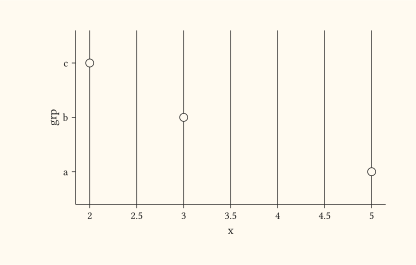
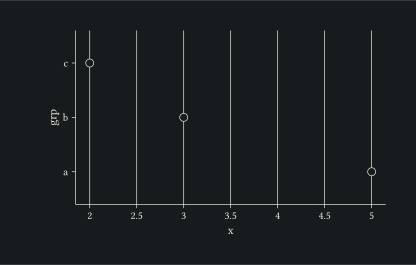
Force level order so bars stay in (a, b, c) regardless of input order.
#let d = (
  (grp: "b", x: 3),
  (grp: "a", x: 5),
  (grp: "c", x: 2),
)
#plot(
  data: d,
  mapping: aes(x: "x", y: "grp"),
  layers: (geom-point(size: 3pt),),
  scales: (scale-y-discrete(limits: ("a", "b", "c")),),
  width: 10cm,
  height: 6cm,
)
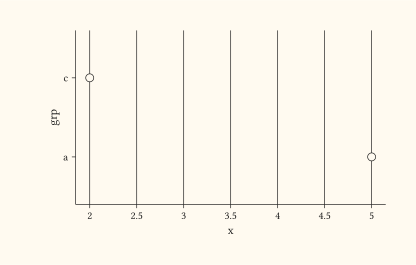
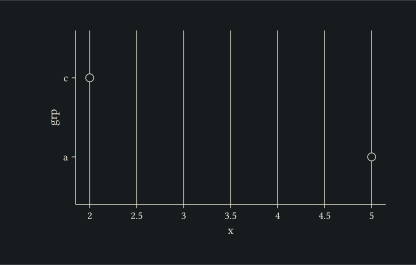
Subset the levels (omit "b") to drop a category from the axis without filtering the underlying data.
#let d = (
  (grp: "a", x: 5),
  (grp: "b", x: 3),
  (grp: "c", x: 2),
)
#plot(
  data: d,
  mapping: aes(x: "x", y: "grp"),
  layers: (geom-point(size: 3pt),),
  scales: (scale-y-discrete(limits: ("a", "c")),),
  width: 10cm,
  height: 6cm,
)