scale-size-binned-area
Binned area-proportional size scale.
Combines binning with area scaling: the domain is partitioned into n-breaks bins, and the size of each bin grows with the square root of its normalised midpoint position.
Usage
scale-size-binned-area(
  n-breaks: 4,
  breaks: auto,
  range: (1pt, 6pt),
  name: none,
  limits: none,
  oob: "drop",
  labels: auto,
)
Parameters
| Parameter | Default | Description |
|---|---|---|
n-breaks |
4 |
Number of bins to partition the domain into. Ignored when breaks is set. |
breaks |
auto |
Array of bin edges for the legend, or auto to derive equal-width bins from n-breaks. Affects the legend only; the per-row mapping stays continuous. |
range |
(1pt, 6pt) |
Pair of Typst lengths (min, max) bounding the output size. |
name |
none |
Legend title. Overrides any name set via labels when both are present. |
limits |
none |
Pair (lo, hi) clipping the trained domain, or none. |
oob |
"drop" |
Out-of-range policy: "drop" (default) removes rows whose value falls outside limits; "squish" clamps continuous values to the nearest endpoint. |
labels |
auto |
Array of legend labels aligned with the bins, or auto. |
Returns
Scale object consumed by plot.
Examples
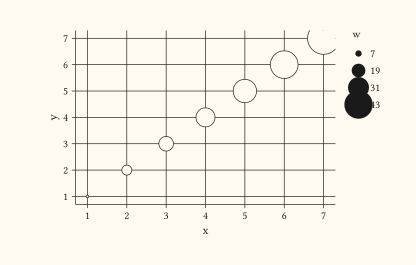
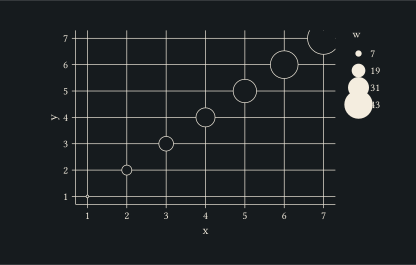
Four-bin area-proportional discretisation on a quadratic series.
#let d = range(1, 8).map(i => (x: i, y: i, w: i * i))
#plot(
  data: d,
  mapping: aes(x: "x", y: "y", size: "w"),
  layers: (geom-point(),),
  scales: (scale-size-binned-area(n-breaks: 4, range: (1pt, 12pt)),),
  width: 10cm,
  height: 6cm,
)
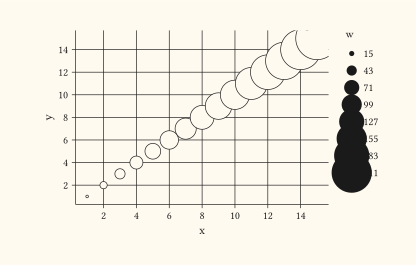
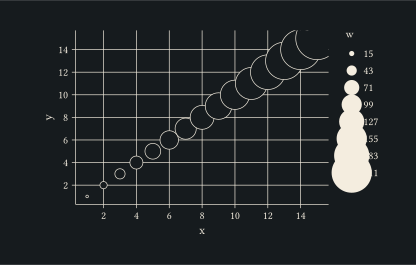
Combine more bins with a wider range for a finer banded area scale on dense data.
#let d = range(1, 16).map(i => (x: i, y: i, w: i * i))
#plot(
  data: d,
  mapping: aes(x: "x", y: "y", size: "w"),
  layers: (geom-point(),),
  scales: (scale-size-binned-area(n-breaks: 8, range: (1pt, 16pt)),),
  width: 10cm,
  height: 6cm,
)