geom-contour-filled
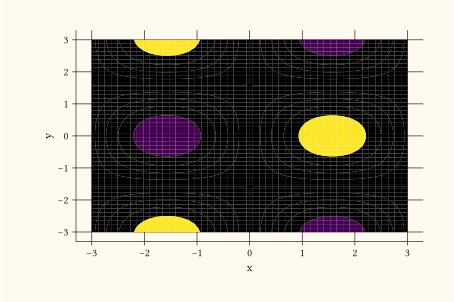
Filled iso-band layer: marching-squares cell clipping over a regular (x, y, z) grid. Pair with a continuous fill scale on _level to shade each band by its lower bound.
Default stroke: none so adjacent cell polygons tile seamlessly. Set stroke explicitly to outline every cell, which is rarely useful unless you want to inspect the partition.
Usage
geom-contour-filled(
  mapping: none,
  data: none,
  bins: 10,
  binwidth: none,
  breaks: auto,
  colour: auto,
  fill: auto,
  stroke: none,
  alpha: auto,
  stat: auto,
  position: "identity",
  key: auto,
  inherit-aes: true,
)
Parameters
| Parameter | Default | Description |
|---|---|---|
mapping |
none |
Layer-specific aesthetic mapping built with aes. Must map x, y, and z. |
data |
none |
Layer-specific dataset, or a function applied to the plot data returning the layer frame. Falls back to the plot data when none. |
bins |
10 |
Target band count. |
binwidth |
none |
Fixed step between successive levels. Overrides bins. |
breaks |
auto |
Explicit array of level boundaries. Overrides the rest. |
colour |
auto |
Cell outline colour. Honoured only when stroke is set. |
fill |
auto |
Cell fill colour. auto lets the fill scale paint by _level. |
stroke |
none |
Outline thickness or stroke dictionary. Defaults to none. |
alpha |
auto |
Cell opacity in [0, 1]. |
stat |
auto |
Statistical transform. auto builds the geom’s default stat from the parameters above; pass a stat name or stat object to override. |
position |
"identity" |
Position adjustment name. Usually left at "identity". |
key |
auto |
Legend glyph override built with a draw-key-* helper. auto picks the default for the geom. |
inherit-aes |
true |
Whether to merge the plot-level mapping into this layer’s mapping. |
Returns
Layer dictionary consumed by plot.
Examples
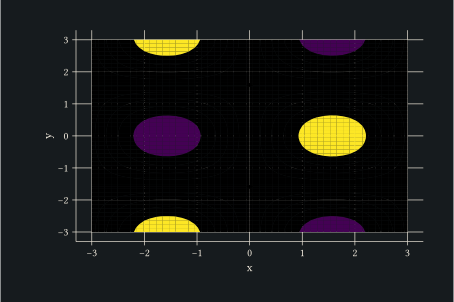
Ten bands on a radial-wave field, shaded by level.
#let n = 50
#let d = ()
#for i in range(n) { for j in range(n) {
  let x = -3 + 6 * i / (n - 1)
  let y = -3 + 6 * j / (n - 1)
  d.push((x: x, y: y, z: calc.sin(x) * calc.cos(y)))
} }
#plot(
  data: d,
  mapping: aes(x: "x", y: "y", z: "z"),
  layers: (geom-contour-filled(bins: 10),),
  scales: scales(
    x: scale-continuous(expand: (0, 0)),
    y: scale-continuous(expand: (0, 0)),
    fill: scale-viridis-c(),
  ),
  width: 11cm,
  height: 7cm,
)