geom-polygon
Polygon layer: one closed filled polygon per group.
Rows are connected in input order and the polygon is closed back to the first vertex. Use group, colour, fill, or linetype to split rows into separate polygons.
Usage
geom-polygon(
  mapping: none,
  data: none,
  colour: auto,
  fill: auto,
  stroke: none,
  alpha: auto,
  stat: "identity",
  position: "identity",
  key: auto,
  inherit-aes: true,
)
Parameters
| Parameter | Default | Description |
|---|---|---|
mapping |
none |
Layer-specific aesthetic mapping built with aes. Must map x, y. |
data |
none |
Layer-specific dataset, or a function applied to the plot data returning the layer frame. Falls back to the plot data when none. |
colour |
auto |
Fixed outline colour. auto resolves via the colour scale, falling back to the theme ink only when neither colour nor fill is set. |
fill |
auto |
Fixed fill colour. auto resolves via the fill scale. |
stroke |
none |
Outline thickness (a Typst length) or stroke dictionary; none disables the outline. |
alpha |
auto |
Fill opacity in [0, 1]. |
stat |
"identity" |
Statistical transform name. Usually "identity". |
position |
"identity" |
Position adjustment name. Usually "identity". |
key |
auto |
Legend glyph override built with a draw-key-* helper. auto picks the default for the geom. |
inherit-aes |
true |
Whether to merge the plot-level mapping into this layer’s mapping. |
Returns
Layer dictionary consumed by plot.
Examples
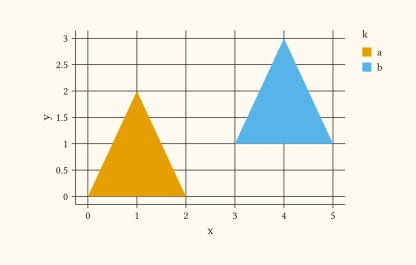
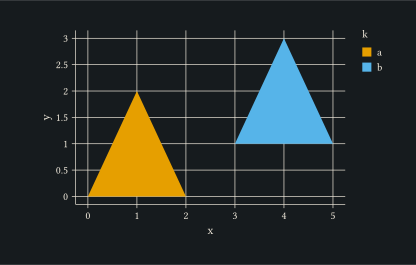
Two filled triangles, each defined by three vertex rows in a shared column.
#let d = (
  (x: 0, y: 0, k: "a"),
  (x: 2, y: 0, k: "a"),
  (x: 1, y: 2, k: "a"),
  (x: 3, y: 1, k: "b"),
  (x: 5, y: 1, k: "b"),
  (x: 4, y: 3, k: "b"),
)
#plot(
  data: d,
  mapping: aes(x: "x", y: "y", fill: "k"),
  layers: (geom-polygon(alpha: 0.5),),
  width: 10cm,
  height: 6cm,
)
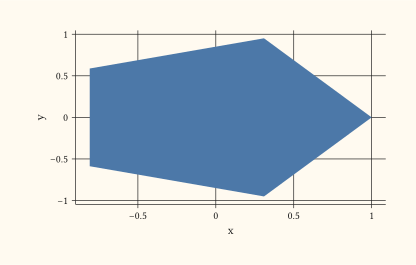
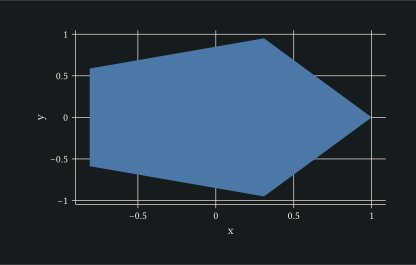
A regular pentagon constructed from sampled angles.
#let n = 5
#let d = range(0, n).map(i => (
  x: calc.cos(2 * calc.pi * i / n),
  y: calc.sin(2 * calc.pi * i / n),
))
#plot(
  data: d,
  mapping: aes(x: "x", y: "y"),
  layers: (geom-polygon(
    fill: rgb("#4c78a8"),
    colour: black,
    stroke: 1pt,
    alpha: 0.7,
  ),),
  width: 10cm,
  height: 6cm,
)