element-text
Text element: font size, weight, colour, and angle.
Pass the result to theme under keys like axis-text, axis-title, legend-text, or legend-title.
Usage
element-text(
  size: none,
  weight: none,
  colour: none,
  angle: none,
  font: none,
  margin: none,
  align: none,
)
Parameters
| Parameter | Default | Description |
|---|---|---|
size |
none |
Text size. Either an absolute Typst length (e.g., 12pt), a ratio (e.g., 80%) scaling the parent surface size, or none to inherit the parent size unchanged. Absolute lengths win outright; ratios cascade proportionally, so setting the base text size resizes every surface that inherits via a ratio. |
weight |
none |
Font weight (e.g., "regular", "bold"), or none to inherit. |
colour |
none |
Text colour, or none to inherit. |
angle |
none |
Rotation angle (a Typst angle), or none to inherit. Honoured on every text surface: axis tick labels (axis-text, seeding the guide-axis angle, which overrides it), axis titles, strip text, the legend title and entry labels, and the plot title, subtitle, and caption. Axis titles fall back to their natural angle (0deg for x, 90deg for y) when unset. |
font |
none |
Font family (e.g., "sans", "serif"), or none to inherit. |
margin |
none |
Per-side spacing built with margin. Each side accepts a Typst length (absolute or relative); em is preferred so spacing scales with the surface font size. Sides left at auto fall through to the renderer default. none keeps every side at the default. |
align |
none |
Horizontal alignment of the text within its surface as a Typst alignment (left, center, right), or none to use the per-surface default (title and subtitle left, caption right, axis titles and strip text centred, legend title left, legend entry labels centred in horizontal legends and left in vertical legends). Independent of the surrounding container’s alignment. Axis tick labels (axis-text) are positioned by anchor and ignore this field. |
Returns
Element dictionary consumed by theme.
Examples
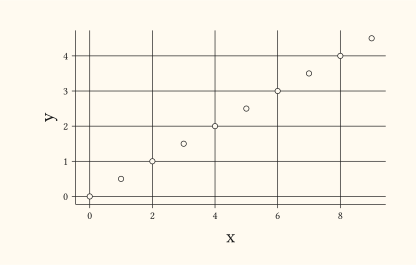
Bigger axis-title font passed via theme.
#let d = range(0, 10).map(i => (x: i, y: i * 0.5))
#plot(
  data: d,
  mapping: aes(x: "x", y: "y"),
  layers: (geom-point(size: 2pt),),
  theme: theme(axis-title: element-text(size: 14pt)),
  width: 10cm,
  height: 6cm,
)
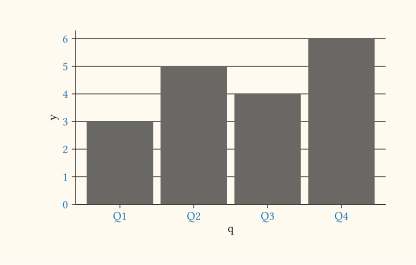
Combine multiple text fields and a rotation angle on axis tick labels.
#let d = (
  (q: "Q1", y: 3), (q: "Q2", y: 5), (q: "Q3", y: 4), (q: "Q4", y: 6),
)
#plot(
  data: d,
  mapping: aes(x: "q", y: "y"),
  layers: (geom-col(),),
  theme: theme(axis-text: element-text(
    size: 9pt,
    angle: 30deg,
    colour: rgb("#1f77b4"),
  )),
  width: 10cm,
  height: 6cm,
)
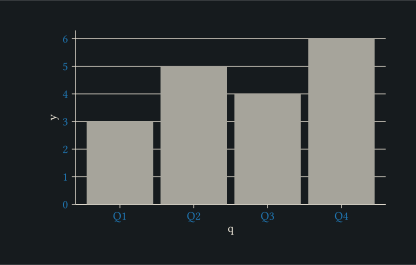
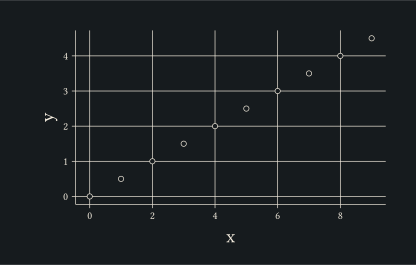
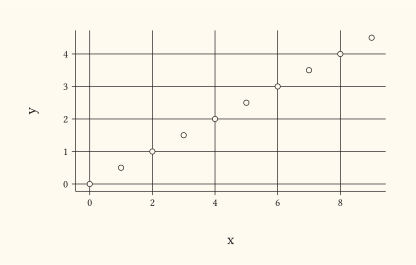
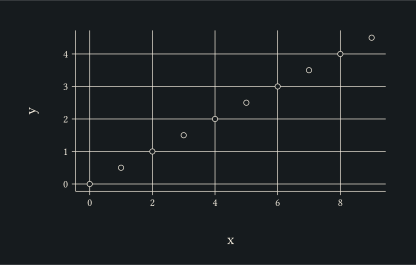
Widen the gap between the axis tick labels and the axis title using a relative margin that tracks the title font size.
#let d = range(0, 10).map(i => (x: i, y: i * 0.5))
#plot(
  data: d,
  mapping: aes(x: "x", y: "y"),
  layers: (geom-point(size: 2pt),),
  theme: theme(axis-title: element-text(
    size: 11pt,
    margin: margin(top: 1.6em, right: 1.6em),
  )),
  width: 10cm,
  height: 6cm,
)
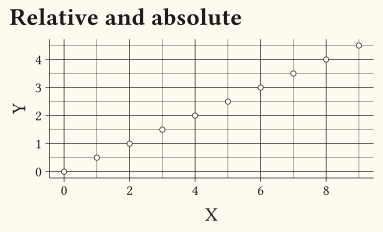
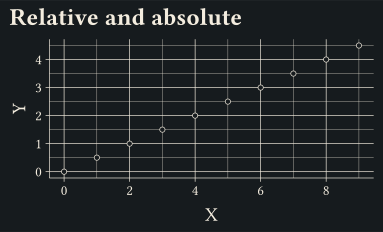
Relative versus absolute sizes: a 12pt base text rescales every inheriting surface, a 120% ratio on the axis titles scales them relative to that base, and an absolute 18pt pins the plot title outright.
#let d = range(0, 10).map(i => (x: i, y: i * 0.5))
#plot(
  data: d,
  mapping: aes(x: "x", y: "y"),
  layers: (geom-point(size: 2pt),),
  labels: labels(title: "Relative and absolute", x: "X", y: "Y"),
  theme: theme(
    text: element-text(size: 12pt),
    axis-title: element-text(size: 120%),
    plot-title: element-text(size: 18pt, weight: "bold"),
  ),
  width: 10cm,
  height: 6cm,
)
See also
theme, element-line, element-rect, element-blank, element-typst, margin.