scale-y-reverse
Continuous y scale flipped bottom-to-top.
Thin wrapper over scale-y-continuous with transform: "reverse". Tick labels stay in data units; only the axis direction reverses.
Usage
scale-y-reverse(
  name: none,
  limits: none,
  oob: "drop",
  breaks: auto,
  minor-breaks: auto,
  n-minor: auto,
  labels: auto,
)
Parameters
| Parameter | Default | Description |
|---|---|---|
name |
none |
Axis title. Overrides any name set via labels when both are present. |
limits |
none |
Pair (lo, hi) clipping the trained domain, or none for automatic limits. Either element may be auto to keep the trained bound on that side. |
oob |
"drop" |
Out-of-range policy: "drop" (default) removes rows whose value falls outside limits; "squish" clamps them to the nearest endpoint. |
breaks |
auto |
Array of break values, or auto for automatic tick selection. |
minor-breaks |
auto |
Array of minor gridline positions, or auto to derive them automatically (midpoints between major breaks, extended one step beyond each end). |
n-minor |
auto |
Number of minor gridlines between adjacent major breaks when minor-breaks is auto; auto resolves to 1. |
labels |
auto |
Array of tick labels aligned with breaks, or auto. |
Returns
Scale object consumed by plot.
Examples
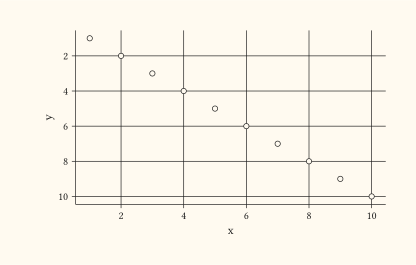
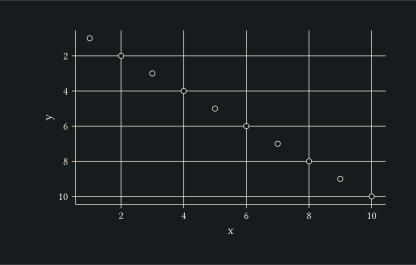
Reverse the y axis so larger values sit at the bottom.
#let d = range(1, 11).map(i => (x: i, y: i))
#plot(
  data: d,
  mapping: aes(x: "x", y: "y"),
  layers: (geom-point(size: 2pt),),
  scales: (scale-y-reverse(name: "y"),),
  width: 10cm,
  height: 6cm,
)
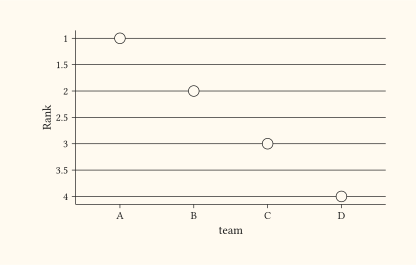
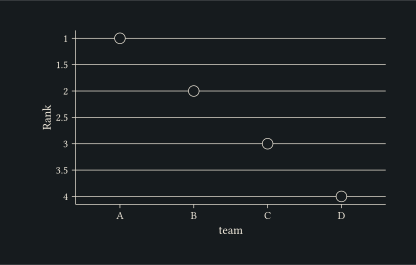
Useful for ranking displays where rank 1 should sit at the top.
#let d = (
  (team: "A", rank: 1),
  (team: "B", rank: 2),
  (team: "C", rank: 3),
  (team: "D", rank: 4),
)
#plot(
  data: d,
  mapping: aes(x: "team", y: "rank"),
  layers: (geom-point(size: 4pt),),
  scales: (scale-y-reverse(name: "Rank", breaks: (1, 2, 3, 4)),),
  width: 10cm,
  height: 6cm,
)