stat-contour
Marching-squares contour statistic.
Treats input rows as samples of a scalar field z over a regular (x, y) grid (one row per Cartesian product cell) and emits the iso-line segments at each level. Pair with geom-path or geom-contour to draw.
Either breaks, binwidth, or bins controls level placement; precedence runs breaks > binwidth > bins (default bins: 10).
Usage
stat-contour(
  bins: 10,
  binwidth: none,
  breaks: auto,
)
Parameters
| Parameter | Default | Description |
|---|---|---|
bins |
10 |
Target contour-level count when breaks and binwidth are unset. |
binwidth |
none |
Fixed step between levels. Overrides bins. |
breaks |
auto |
Explicit array of contour levels. Overrides bins and binwidth. |
Returns
Statistic object with name: "contour".
Outputs
x.y.group._level.
Examples
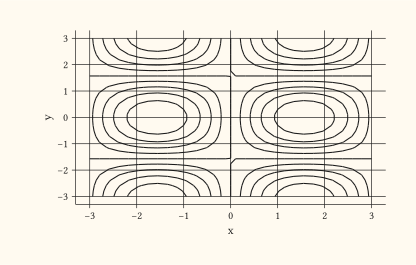
Drive geom-path with the constructor form over a sin(x) * cos(y) grid to trace eight iso-lines.
#let n = 30
#let d = ()
#for i in range(n) { for j in range(n) {
  let x = -3 + 6 * i / (n - 1)
  let y = -3 + 6 * j / (n - 1)
  d.push((x: x, y: y, z: calc.sin(x) * calc.cos(y)))
} }
#plot(
  data: d,
  mapping: aes(x: "x", y: "y", z: "z"),
  layers: (geom-path(stat: stat-contour(bins: 8)),),
  width: 10cm,
  height: 6cm,
)