geom-curve
Curved segment layer: one quadratic bezier from (x, y) to (xend, yend) per row.
curvature chooses the magnitude and side of the bow:
0collapses to a straightgeom-segment.- Positive values curve to the right of the chord (looking from start to end).
- Negative values curve to the left.
angle shifts the control point along the chord (in addition to the perpendicular offset), producing asymmetric arcs. 90deg gives a symmetric bow; smaller or larger angles bias the apex toward one end.
Usage
geom-curve(
  mapping: none,
  data: none,
  curvature: 0.5,
  angle: 90deg,
  n: 32,
  stroke: auto,
  colour: auto,
  alpha: auto,
  linetype: auto,
  arrow: none,
  stat: "identity",
  position: "identity",
  key: auto,
  inherit-aes: true,
)
Parameters
| Parameter | Default | Description |
|---|---|---|
mapping |
none |
Layer-specific aesthetic mapping built with aes. Must map x, y, xend, yend. |
data |
none |
Layer-specific dataset, or a function applied to the plot data returning the layer frame. Falls back to the plot data when none. |
curvature |
0.5 |
Bezier-control offset as a fraction of the chord length. 0 draws a straight segment; sign flips the side of the bow. |
angle |
90deg |
Apex angle in (0deg, 180deg). 90deg is symmetric. |
n |
32 |
Number of polyline samples along the curve. |
stroke |
auto |
Line thickness (a Typst length). |
colour |
auto |
Fixed line colour. auto resolves via the colour scale. |
alpha |
auto |
Line opacity in [0, 1]. |
linetype |
auto |
Dash keyword (e.g., "solid", "dashed"). auto honours the linetype scale. |
arrow |
none |
Arrowhead spec built with arrow, marking the direction of each curve. The head is tangent to the sampled bezier. none draws no head. |
stat |
"identity" |
Statistical transform name. Usually "identity". |
position |
"identity" |
Position adjustment name. Usually "identity". |
key |
auto |
Legend glyph override built with a draw-key-* helper. auto picks the default for the geom. |
inherit-aes |
true |
Whether to merge the plot-level mapping into this layer’s mapping. |
Returns
Layer dictionary consumed by plot.
Examples
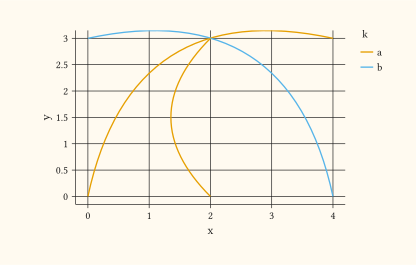
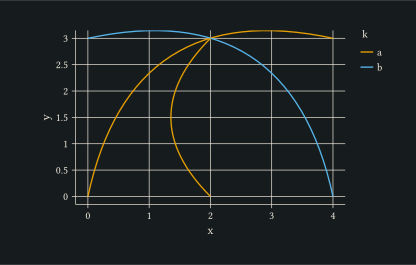
Three curved connectors with the default symmetric bow.
#let d = (
  (x: 0, y: 0, xend: 4, yend: 3, k: "a"),
  (x: 0, y: 3, xend: 4, yend: 0, k: "b"),
  (x: 2, y: 0, xend: 2, yend: 3, k: "a"),
)
#plot(
  data: d,
  mapping: aes(x: "x", y: "y", xend: "xend", yend: "yend", colour: "k"),
  layers: (geom-curve(curvature: 0.5, stroke: 1pt),),
  width: 10cm,
  height: 6cm,
)
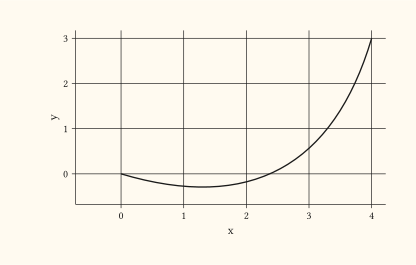
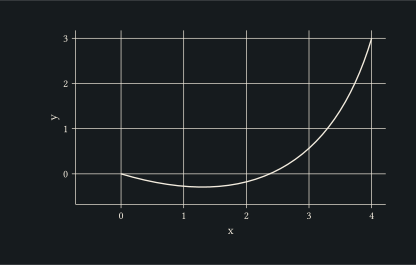
Negative curvature flips the arc to the other side.
#let d = ((x: 0, y: 0, xend: 4, yend: 3),)
#plot(
  data: d,
  mapping: aes(x: "x", y: "y", xend: "xend", yend: "yend"),
  layers: (geom-curve(curvature: -0.5, stroke: 1pt),),
  width: 10cm,
  height: 6cm,
)
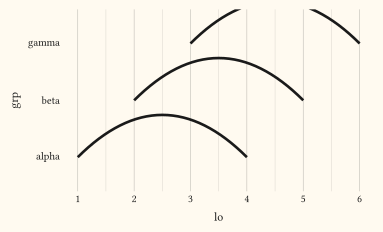
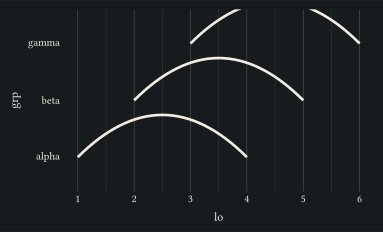
Curved connectors on a discrete y axis: endpoints resolve through the trained scale, so categorical slots work.
#let d = (
  (lo: 1, hi: 4, grp: "alpha"),
  (lo: 2, hi: 5, grp: "beta"),
  (lo: 3, hi: 6, grp: "gamma"),
)
#plot(
  data: d,
  mapping: aes(x: "lo", y: "grp", xend: "hi", yend: "grp"),
  layers: (geom-curve(stroke: 2pt),),
  scales: scales(y: scale-discrete()),
  width: 10cm,
  height: 6cm,
)
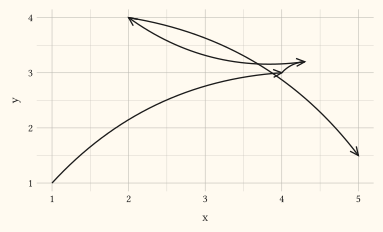
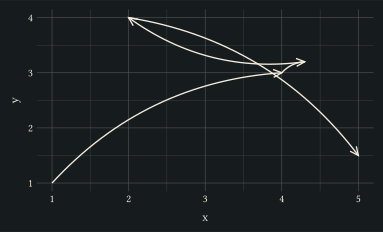
A connected scatter read in time order: an arrow head on each hop carries the direction whatever the hop is long enough to show.
#let stops = ((1, 1), (4, 3), (4.3, 3.2), (2, 4), (5, 1.5))
#let d = range(0, stops.len() - 1).map(i => (
  x: stops.at(i).at(0), y: stops.at(i).at(1),
  xend: stops.at(i + 1).at(0), yend: stops.at(i + 1).at(1),
))
#plot(
  data: d,
  mapping: aes(x: "x", y: "y", xend: "xend", yend: "yend"),
  layers: (
    geom-curve(curvature: 0.2, stroke: 1pt, arrow: arrow(length: 7pt)),
  ),
  width: 10cm,
  height: 6cm,
)