position-dodge
Dodge position adjustment: place grouped marks side by side.
Typically set on a layer as position: "dodge" rather than constructed directly; the constructor exists for symmetry with the other positions. When all marks at a given x share the same width, they split the bucket into equal slots and padding sets the gap between them. When widths differ (per-row width column), each mark uses its own width as its slot, with padding between slots and a shrink-to-fit if total slot use would exceed the bucket.
Usage
position-dodge(
  width: 0.9,
  padding: 0.1,
)
Parameters
| Parameter | Default | Description |
|---|---|---|
width |
0.9 |
Total width reserved for the dodged group, as a fraction of the category width. |
padding |
0.1 |
Gap between adjacent dodge slots. With uniform widths it is a fraction of one slot; with mixed widths it is a fraction of the bucket. |
Returns
Position dictionary with name: "dodge", consumed by plot.
Examples
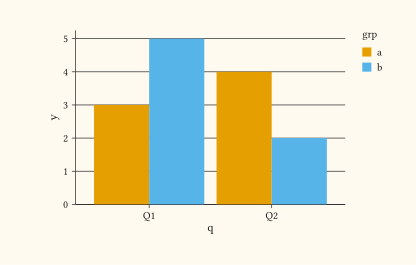
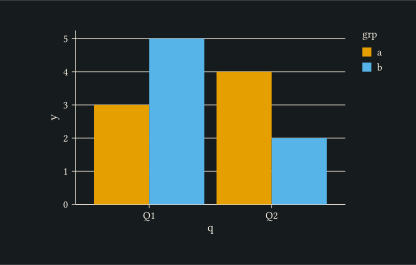
Bars dodged side by side per fill group within each x slot.
#let d = (
  (q: "Q1", grp: "a", y: 3),
  (q: "Q1", grp: "b", y: 5),
  (q: "Q2", grp: "a", y: 4),
  (q: "Q2", grp: "b", y: 2),
)
#plot(
  data: d,
  mapping: aes(x: "q", y: "y", fill: "grp", label: "y"),
  layers: (
    geom-col(position: "dodge"),
    geom-label(position: "dodge", size: 14pt),
  ),
  width: 10cm,
  height: 6cm,
)
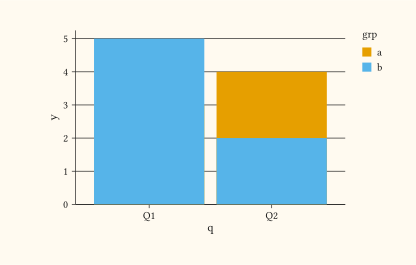
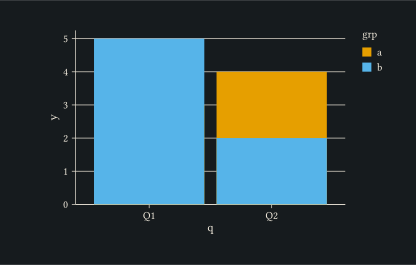
Increase padding to widen the gap between dodged bars.
#let d = (
  (q: "Q1", grp: "a", y: 3),
  (q: "Q1", grp: "b", y: 5),
  (q: "Q2", grp: "a", y: 4),
  (q: "Q2", grp: "b", y: 2),
)
#plot(
  data: d,
  mapping: aes(x: "q", y: "y", fill: "grp"),
  layers: (geom-col(position: position-dodge(padding: 0.3)),),
  width: 10cm,
  height: 6cm,
)
See also
position-stack, position-fill, position-identity, position-jitter.