geom-area
Area layer: filled polygon from y = 0 up to y along x, per group.
Mapping must provide x and y. Discrete colour, fill, or group mappings split rows into separate filled polygons drawn back to front.
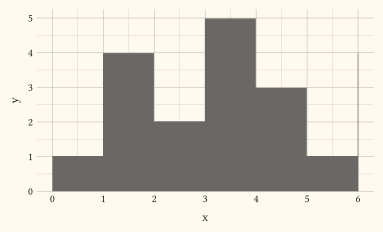
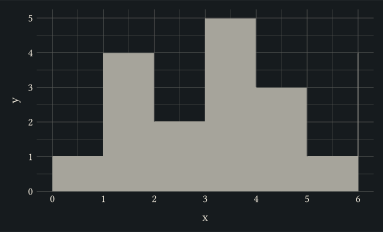
(default) draws a smooth polygon; "hv" (horizontal then vertical) or "vh" (vertical then horizontal) step the top edge like geom-step.
resamples all groups onto a shared x-grid before stacking so bands join cleanly even when groups carry different x values. Pass "identity" to skip alignment.
Usage
geom-area(
  mapping: none,
  data: none,
  colour: auto,
  fill: auto,
  stroke: none,
  alpha: auto,
  direction: none,
  stat: "align",
  position: "stack",
  key: auto,
  inherit-aes: true,
)
Parameters
| Parameter | Default | Description |
|---|---|---|
mapping |
none |
Layer-specific aesthetic mapping built with aes. Falls back to the plot mapping when none. |
data |
none |
Layer-specific dataset, or a function applied to the plot data returning the layer frame. Falls back to the plot data when none. |
colour |
auto |
Fixed outline colour. auto resolves via the colour scale, falling back to the theme ink only when neither colour nor fill is set. |
fill |
auto |
Fixed fill colour. auto resolves via the fill scale, the colour scale, or a neutral default. |
stroke |
none |
Outline thickness (a Typst length) or stroke dictionary; none disables the outline. |
alpha |
auto |
Fill opacity in [0, 1]. |
direction |
none |
Step interpolation for the filled top edge. none |
stat |
"align" |
Statistical transform name. Defaults to "align", which |
position |
"stack" |
Position adjustment name. Defaults to "stack". |
key |
auto |
Legend glyph override built with a draw-key-* helper. auto picks the default for the geom. |
inherit-aes |
true |
Whether to merge the plot-level mapping into this layer’s mapping. |
Returns
Layer dictionary consumed by plot.
Examples
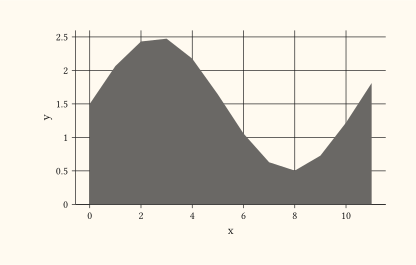
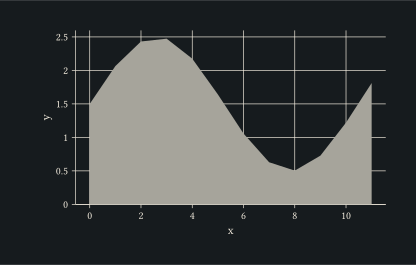
Single filled area between y = 0 and a smooth curve.
#let d = range(0, 12).map(i => (x: i, y: calc.sin(i * 0.6) + 1.5))
#plot(
  data: d,
  mapping: aes(x: "x", y: "y"),
  layers: (geom-area(alpha: 0.4),),
  width: 10cm,
  height: 6cm,
)
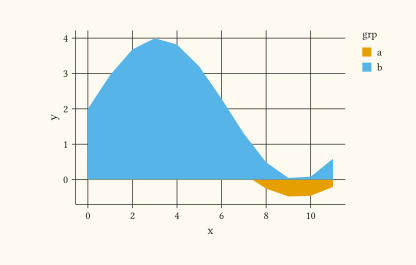
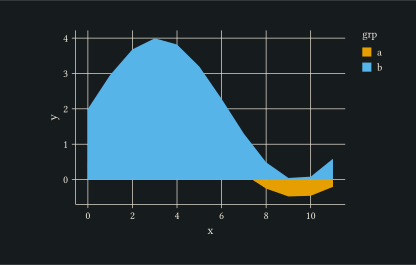
Map fill to a discrete column; groups stack automatically.
#let d = ()
#for grp in ("a", "b") {
  for i in range(0, 12) {
    d.push((x: i, y: 1.5 + calc.sin(i * 0.5) + (if grp == "b" { 1 } else { 0 }), grp: grp))
  }
}
#plot(
  data: d,
  mapping: aes(x: "x", y: "y", fill: "grp"),
  layers: (geom-area(alpha: 0.6),),
  width: 10cm,
  height: 6cm,
)
Step the top edge with direction: "hv" for a histogram-like filled area.
#let d = range(0, 7).map(i => (x: i, y: calc.rem(i * 3, 5) + 1))
#plot(
  data: d,
  mapping: aes(x: "x", y: "y"),
  layers: (geom-area(direction: "hv", alpha: 0.4),),
  width: 10cm,
  height: 6cm,
)