stat-boxplot
Boxplot statistic: per-x five-number summary with outlier list.
One output row per distinct x value with keys (x, lower, middle, upper, ymin, ymax, outliers). lower, middle, and upper are the quartiles of the input y values; ymin and ymax are the smallest and largest y still inside the 1.5 × IQR fence; values outside the fence land in outliers.
Usage
stat-boxplot(
  coefficient: 1.5,
)
Parameters
| Parameter | Default | Description |
|---|---|---|
coefficient |
1.5 |
Whisker length as a multiple of the inter-quartile range. |
Returns
Statistic object with name: "boxplot", consumed by geom layers.
Outputs
x.lower.middle.upper.ymin.ymax.whisker-lo.whisker-hi.outliers.
Examples
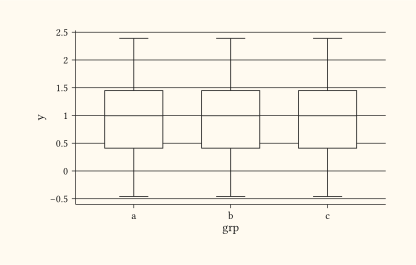
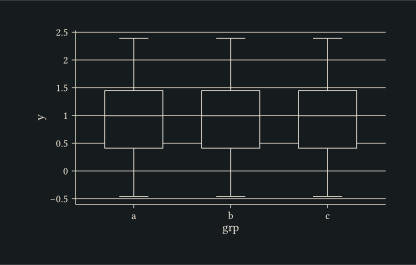
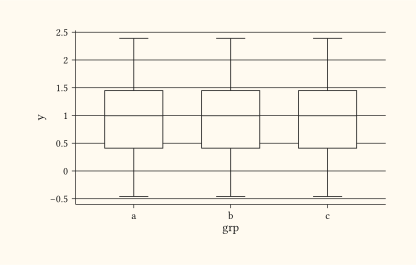
Default 1.5 × IQR whisker rule on grouped raw observations.
#let ys = (1, 2, 3, 4, 5, 6, 7, 8, 9, 13)
#let d = ()
#for grp in ("a", "b", "c") {
  for y in ys {
    d.push((grp: grp, y: y))
  }
}
#plot(
  data: d,
  mapping: aes(x: "grp", y: "y"),
  layers: (geom-boxplot(),),
  width: 10cm,
  height: 6cm,
)
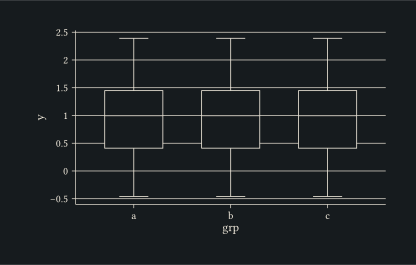
stat: "boxplot" is equivalent to stat: stat-boxplot() with the default coefficient: 1.5. Use the constructor to customise the whisker length, e.g., stat: stat-boxplot(coefficient: 1.0) tightens the fence so more values surface as outliers.
#let ys = (1, 2, 3, 4, 5, 6, 7, 8, 9, 13)
#let d = ()
#for grp in ("a", "b", "c") {
  for y in ys {
    d.push((grp: grp, y: y))
  }
}
#plot(
  data: d,
  mapping: aes(x: "grp", y: "y"),
  layers: (geom-boxplot(stat: stat-boxplot(coefficient: 1.0)),),
  width: 10cm,
  height: 6cm,
)