geom-label
Boxed text label layer reading strings from the label aesthetic.
One boxed text block is drawn per row at the mapped (x, y). The box takes its own fill, stroke, inset, and corner radius. Offsets are read from the nudge-x and nudge-y aesthetics: a number shifts in data units, a Typst length shifts in canvas units. Setting segment: true draws a connector back to the anchor that avoids the other label boxes of the same layer.
Usage
geom-label(
  mapping: none,
  data: none,
  size: 8pt,
  colour: auto,
  font: auto,
  fill: auto,
  stroke: 0.4pt,
  alpha: auto,
  inset: 2pt,
  radius: 1pt,
  anchor: "center",
  angle: 0deg,
  segment: false,
  segment-colour: auto,
  segment-stroke: 0.4pt,
  min-segment-length: 0.05,
  arrow: none,
  box-padding: 0.05,
  repel: false,
  point-padding: 0.05,
  max-iter: 100,
  force-pull: 0.1,
  force-push: 0.2,
  force-segment: 0.3,
  seed: 0,
  stat: "identity",
  position: "identity",
  key: auto,
  inherit-aes: true,
)
Parameters
| Parameter | Default | Description |
|---|---|---|
mapping |
none |
Layer-specific aesthetic mapping built with aes. Must map x, y, and label. May map nudge-x and nudge-y for per-row offsets, in data units on a continuous scale and in level units on a discrete one. |
data |
none |
Layer-specific dataset, or a function applied to the plot data returning the layer frame. Falls back to the plot data when none. |
size |
8pt |
Text size (a Typst length). |
colour |
auto |
Paint applied to both the box outline and the label text. auto resolves via the colour scale, falling back to the theme ink only when neither colour nor fill is set. |
font |
auto |
Label font family. auto uses the theme text font, then the document font. |
fill |
auto |
Box fill colour. auto resolves via the fill scale, falling back to the theme paper only when neither colour nor fill is set. |
stroke |
0.4pt |
Box outline thickness (a Typst length) or stroke dictionary; none disables the outline. |
alpha |
auto |
Box and text opacity in [0, 1]. auto honours any mapped alpha aesthetic. |
inset |
2pt |
Padding between text and box border (a Typst length). |
radius |
1pt |
Corner radius of the box (a Typst length). |
anchor |
"center" |
CeTZ anchor (e.g., "center", "west") controlling placement. |
angle |
0deg |
Rotation applied to each label box (a Typst angle, e.g., 45deg). Positive angles rotate anticlockwise about the anchor. |
segment |
false |
Draw a connector from each box back to its anchor point. When true, the connector is routed to avoid the AABBs of other boxes of the same layer; dropped when no L-bend clears the obstacles. |
segment-colour |
auto |
Connector paint. auto inherits the theme ink. |
segment-stroke |
0.4pt |
Connector thickness (a Typst length). |
min-segment-length |
0.05 |
Connectors shorter than this distance (canvas units, 1 = 1cm) are suppressed. |
arrow |
none |
Arrowhead spec built with arrow, drawn on the connector. ends: "last" (the default) marks the anchor end, ends: "first" the label end. none draws a plain connector. |
box-padding |
0.05 |
Extra cm padding added around each measured box when routing connectors. |
repel |
false |
Repel boxes off each other (and off their anchor points) via an iterative force-based layout, ggrepel-style. Pair with segment: true to keep the visual link to each anchor. |
point-padding |
0.05 |
Minimum clearance (cm) between a box and any anchor point when repel is on. |
max-iter |
100 |
Maximum number of repulsion iterations. |
force-pull |
0.1 |
Strength of the spring pull that keeps each box near its anchor. |
force-push |
0.2 |
Strength of the repulsion between overlapping boxes. |
force-segment |
0.3 |
Strength of the penalty that pushes a box off another label’s connector path. |
seed |
0 |
Random seed for the small initial jitter applied to coincident anchors. |
stat |
"identity" |
Statistical transform name. Usually "identity". |
position |
"identity" |
Position adjustment name. Usually "identity"; pass "nudge" to shift labels off their points. |
key |
auto |
Legend glyph override built with a draw-key-* helper. auto picks the default for the geom. |
inherit-aes |
true |
Whether to merge the plot-level mapping into this layer’s mapping. |
Returns
Layer dictionary consumed by plot.
Examples
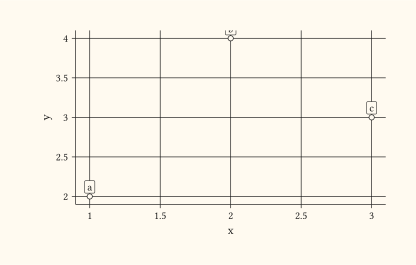
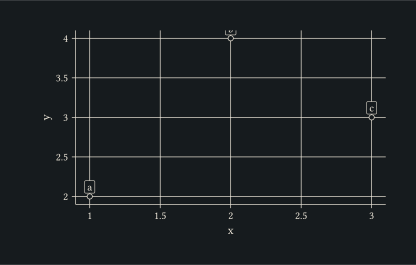
Default boxed labels nudged above their points.
#let d = (
  (x: 1, y: 2, name: "a"),
  (x: 2, y: 4, name: "b"),
  (x: 3, y: 3, name: "c"),
)
#plot(
  data: d,
  mapping: aes(x: "x", y: "y", label: "name"),
  layers: (
    geom-point(size: 2pt),
    geom-label(mapping: aes(nudge-y: 0.25cm)),
  ),
  scales: scales(y: scale-continuous(expand: 15%)),
  width: 10cm,
  height: 6cm,
)
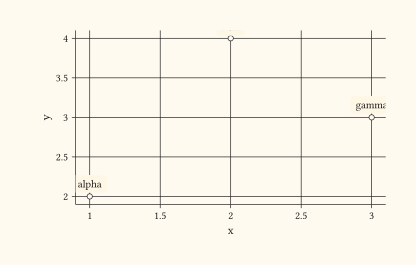
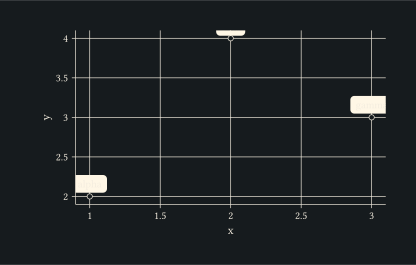
Customise fill, stroke, and radius to match a coloured callout style.
#let d = (
  (x: 1, y: 2, name: "alpha"),
  (x: 2, y: 4, name: "beta"),
  (x: 3, y: 3, name: "gamma"),
)
#plot(
  data: d,
  mapping: aes(x: "x", y: "y", label: "name"),
  layers: (
    geom-label(
      mapping: aes(nudge-y: 0.3cm),
      fill: rgb("#fff7e6"),
      colour: rgb("#cc7a00"),
      stroke: 0.6pt,
      radius: 3pt,
      inset: 4pt,
    ),
  ),
  scales: scales(y: scale-continuous(expand: 15%)),
  width: 10cm,
  height: 6cm,
)