geom-ellipse
Ellipse layer: draws one closed ellipse per row from (x0, y0, a, b, angle).
x0/y0 give the centre in data units; a/b are the semi-major and semi-minor radii in data units; angle is the rotation in radians from the x axis. Each row is sampled into a 64-vertex polygon and rendered through the polygon draw path.
Usage
geom-ellipse(
  mapping: none,
  data: none,
  a: 1,
  b: 1,
  angle: 0,
  n: 64,
  colour: auto,
  fill: auto,
  stroke: none,
  alpha: auto,
  stat: "identity",
  position: "identity",
  key: auto,
  inherit-aes: true,
)
Parameters
| Parameter | Default | Description |
|---|---|---|
mapping |
none |
Layer-specific aesthetic mapping built with aes. Must map x0, y0. a, b, and angle may be mapped or left to the layer-level fallbacks. |
data |
none |
Layer-specific dataset, or a function applied to the plot data returning the layer frame. Falls back to the plot data when none. |
a |
1 |
Layer-level semi-major radius in data units used when aes(a: ...) is not mapped. |
b |
1 |
Layer-level semi-minor radius in data units used when aes(b: ...) is not mapped. |
angle |
0 |
Layer-level rotation in radians used when aes(angle: ...) is not mapped. |
n |
64 |
Number of polygon vertices sampled around the ellipse. |
colour |
auto |
Fixed outline colour. auto resolves via the colour scale. |
fill |
auto |
Fixed fill colour. auto resolves via the fill scale. |
stroke |
none |
Outline thickness (a Typst length) or stroke dictionary; none disables the outline. |
alpha |
auto |
Fill opacity in [0, 1]. |
stat |
"identity" |
Statistical transform name. Usually "identity". |
position |
"identity" |
Position adjustment name. Usually "identity". |
key |
auto |
Legend glyph override built with a draw-key-* helper. auto picks the default for the geom. |
inherit-aes |
true |
Whether to merge the plot-level mapping into this layer’s mapping. |
Returns
Layer dictionary consumed by plot.
Examples
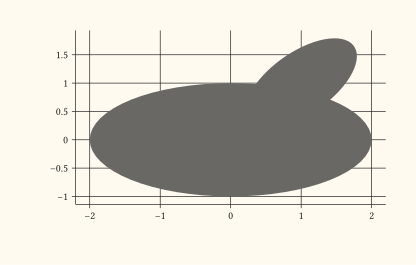
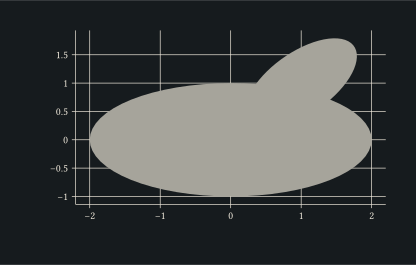
Two ellipses with different radii and rotation.
#let d = (
  (x0: 0, y0: 0, a: 2, b: 1, angle: 0),
  (x0: 1, y0: 1, a: 1, b: 0.5, angle: calc.pi / 4),
)
#plot(
  data: d,
  mapping: aes(x0: "x0", y0: "y0", a: "a", b: "b", angle: "angle"),
  layers: (geom-ellipse(alpha: 0.4),),
  width: 10cm,
  height: 6cm,
)