stat-summary-bin
Summary statistic over uniform x bins.
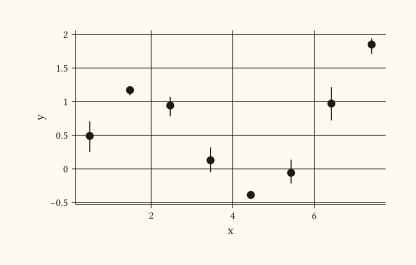
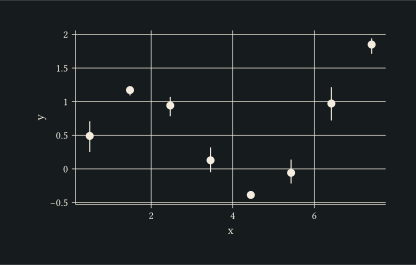
Partitions x into uniform-width bins (same rule as stat-bin), then for every bin reduces the y values inside to a (x, y, ymin, ymax) row where x is the bin midpoint. The reduction is chosen by fun; supported names are "mean-se", "mean-cl-normal", "mean-sd", and "median-hilow".
Either bins or binwidth fixes the partition; if both are supplied, binwidth wins.
Usage
stat-summary-bin(
  fun: "mean-se",
  bins: 30,
  binwidth: none,
  fun-args: (:),
)
Parameters
| Parameter | Default | Description |
|---|---|---|
fun |
"mean-se" |
Name of the summary helper to apply to each bin’s y values. |
bins |
30 |
Target number of bins when binwidth is none. |
binwidth |
none |
Fixed bin width. Overrides bins when set. |
fun-args |
(:) |
Keyword arguments forwarded to the helper. |
Returns
Statistic object with name: "summary-bin", consumed by geom layers.
Outputs
x.y.ymin.ymax.
Examples
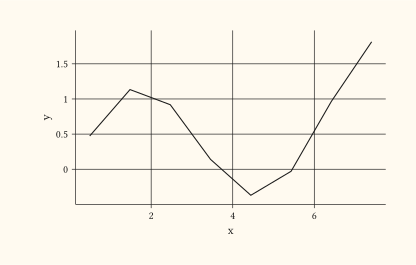
Mean and standard-error bands per bin, drawn as a polyline.
#let d = range(0, 80).map(i => (x: i / 10, y: calc.sin(i / 10) + i / 80))
#plot(
  data: d,
  mapping: aes(x: "x", y: "y"),
  layers: (
    geom-line(stat: stat-summary-bin(fun: "mean-se", bins: 8)),
  ),
  width: 10cm,
  height: 6cm,
)
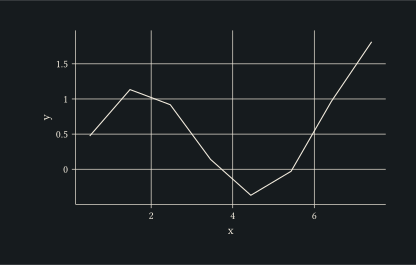
stat: "summary-bin" is equivalent to stat: stat-summary-bin() with defaults (fun: "mean-se", bins: 30). Use the constructor to customise the reduction or partition.
#let d = range(0, 80).map(i => (x: i / 10, y: calc.sin(i / 10) + i / 80))
#plot(
  data: d,
  mapping: aes(x: "x", y: "y"),
  layers: (
    geom-pointrange(
      size: 3pt,
      stat: stat-summary-bin(fun: "median-hilow", bins: 8),
    ),
  ),
  width: 10cm,
  height: 6cm,
)