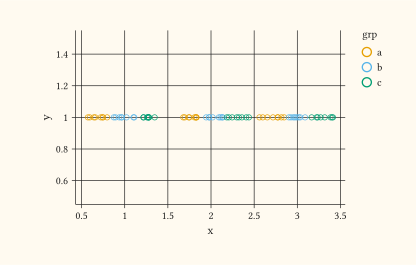
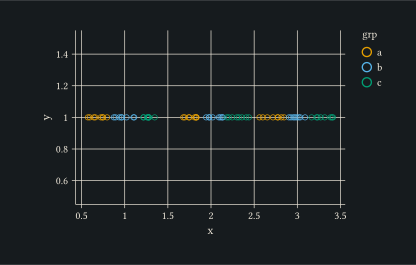
position-jitterdodge
Combined dodge then jitter position adjustment.
Applies dodge to spread groups across each x bucket, then jitters within each dodged slot so overlapping points become visible. The same seed always produces the same offsets so renders are reproducible.
Usage
position-jitterdodge(
  width: 0.4,
  height: 0,
  dodge-width: 0.75,
  seed: 0,
)
Parameters
| Parameter | Default | Description |
|---|---|---|
width |
0.4 |
Maximum absolute jitter applied to the (already dodged) x position, in data units. |
height |
0 |
Maximum absolute jitter applied to the y position, in data units. |
dodge-width |
0.75 |
Total width reserved for the dodged group, as a fraction of the category width. |
seed |
0 |
Integer seed for the deterministic pseudo-random offsets. |
Returns
Position dictionary with name: "jitterdodge", consumed by plot.
Examples
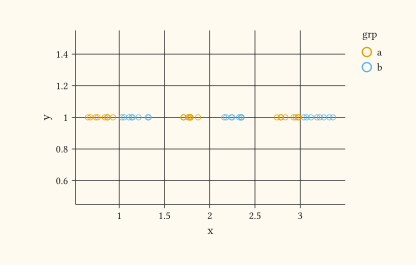
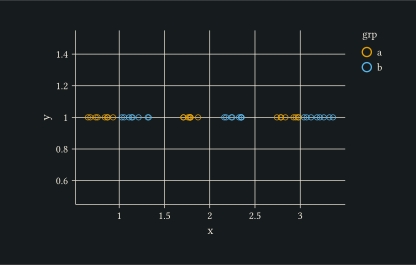
Dodge by colour then jitter within each slot, useful for dense categorical scatters.
#let d = ()
#for x in (1, 2, 3) {
  for grp in ("a", "b") {
    for _ in range(0, 8) { d.push((x: x, y: 1, grp: grp)) }
  }
}
#plot(
  data: d,
  mapping: aes(x: "x", y: "y", colour: "grp"),
  layers: (
    geom-jitter(size: 2pt, position: position-jitterdodge()),
  ),
  width: 10cm,
  height: 6cm,
)
Tune dodge-width and width to keep jittered clusters inside their dodged slots.
#let d = ()
#for x in (1, 2, 3) {
  for grp in ("a", "b", "c") {
    for _ in range(0, 8) { d.push((x: x, y: 1, grp: grp)) }
  }
}
#plot(
  data: d,
  mapping: aes(x: "x", y: "y", colour: "grp"),
  layers: (geom-jitter(
    size: 2pt,
    position: position-jitterdodge(dodge-width: 0.9, width: 0.15),
  ),),
  width: 10cm,
  height: 6cm,
)