stat-manual
Manual statistic: run a closure on the data array inside the layer.
fun is invoked with data (an array of row dictionaries). The result replaces the layer’s data; mapping is unchanged. Use it for ad-hoc transforms with no dedicated stat counterpart (e.g., centroids, hulls, running totals).
Usage
stat-manual(
  fun: _identity,
)
Parameters
| Parameter | Default | Description |
|---|---|---|
fun |
_identity |
Closure data => data taking the row array and returning the transformed array. Defaults to identity. |
Returns
Statistic object with name: "manual", consumed by geom layers.
Outputs
This stat passes input rows through unchanged.
Examples
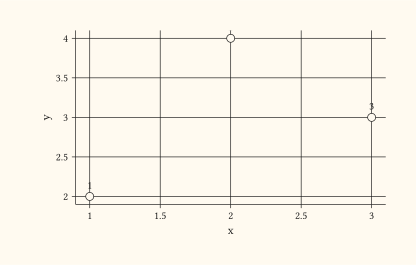
Compute a per-row index column inside the layer pipeline and label it via geom-text.
#let d = (
  (x: 1, y: 2),
  (x: 2, y: 4),
  (x: 3, y: 3),
)
#let with-index = data => data.enumerate().map(((i, r)) => r + (label: str(i + 1)))
#plot(
  data: d,
  mapping: aes(x: "x", y: "y", label: "label"),
  layers: (
    geom-point(size: 3pt),
    geom-text(stat: stat-manual(fun: with-index), mapping: aes(nudge-y: 0.3cm)),
  ),
  width: 10cm,
  height: 6cm,
)