geom-path
Path layer connecting observations in row order, one path per group.
Grouping is implicit on discrete aesthetics (colour, fill, linetype) or the explicit group mapping, just like geom-line.
Usage
geom-path(
  mapping: none,
  data: none,
  stroke: auto,
  colour: auto,
  alpha: auto,
  linetype: auto,
  arrow: none,
  key: auto,
  stat: "identity",
  position: "identity",
  inherit-aes: true,
)
Parameters
| Parameter | Default | Description |
|---|---|---|
mapping |
none |
Layer-specific aesthetic mapping built with aes. Falls back to the plot mapping when none. |
data |
none |
Layer-specific dataset, or a function applied to the plot data returning the layer frame. Falls back to the plot data when none. |
stroke |
auto |
Line thickness (a Typst length). |
colour |
auto |
Fixed line colour. auto resolves via the colour scale or a neutral default. |
alpha |
auto |
Line opacity in [0, 1]. |
linetype |
auto |
Dash keyword (e.g., "solid", "dashed"). auto honours the linetype scale. |
arrow |
none |
Arrowhead spec built with arrow, marking which way each group’s path runs. The head sits at the end of the whole path, not at every join. none draws no head. |
key |
auto |
Legend glyph override built with a draw-key-* helper. auto picks the default for the geom. |
stat |
"identity" |
Statistical transform name. Usually "identity". |
position |
"identity" |
Position adjustment name. Usually "identity". |
inherit-aes |
true |
Whether to merge the plot-level mapping into this layer’s mapping. |
Returns
Layer dictionary consumed by plot.
Examples
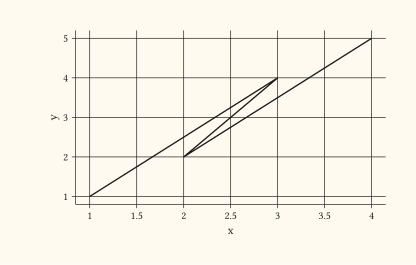
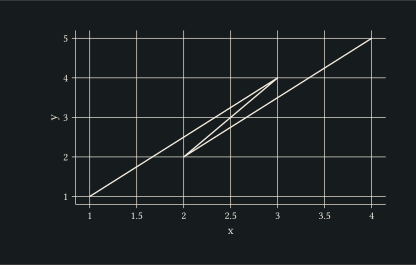
Connect rows in input order (deliberately not sorted by x).
#let d = (
  (x: 1, y: 1), (x: 3, y: 4), (x: 2, y: 2), (x: 4, y: 5),
)
#plot(
  data: d,
  mapping: aes(x: "x", y: "y"),
  layers: (geom-path(stroke: 1pt),),
  width: 10cm,
  height: 6cm,
)
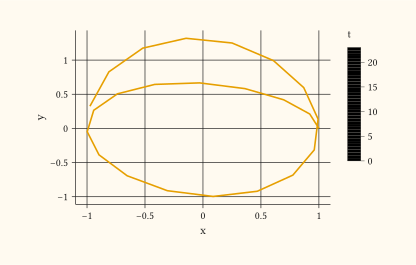
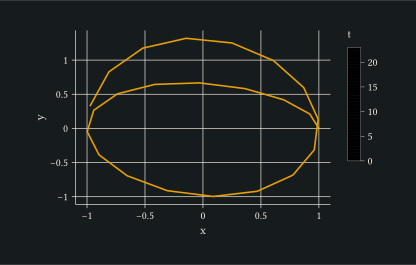
Trajectory of a moving point parameterised by t, drawn in time order with a coloured fade.
#let d = range(0, 24).map(t => (
  x: calc.cos(t * 0.4), y: calc.sin(t * 0.4) * (t / 24 + 0.5), t: t,
))
#plot(
  data: d,
  mapping: aes(x: "x", y: "y", colour: "t"),
  layers: (geom-path(stroke: 1.2pt),),
  width: 10cm,
  height: 6cm,
)