annotate
Build a one-row annotation layer dispatching to a named geom.
Splits keyword arguments into two groups: those whose names match an aesthetic channel (see _aes-keys) become a single-row inline dataset plus an aesthetic mapping pointing each channel at the matching column, and the remainder are forwarded verbatim to the geom constructor as layer parameters. The resulting layer always has inherit-aes: false so it does not pick up the plot-level mapping.
Usage
annotate(
  geom,
  ..fields,
)
Parameters
| Parameter | Default | Description |
|---|---|---|
geom |
Geom name to dispatch to. One of "text", "point", "label", "segment", "rect", "vline", "hline", "abline". |
|
clip |
Whether the annotation is clipped to the plot area. true (default) clips like any other layer; false lets the annotation overflow the panel, e.g., a corner inset or a mark placed past the axis limits. Unclipped annotations are drawn above every clipped layer regardless of their position in layers, so they read as deliberate overlays. A clip: false annotation is also exempt from the out-of-range pre-pass, so a position outside the scale limits is kept instead of dropped. |
|
..fields |
Named arguments split between aesthetics and layer parameters. Aesthetic names are x, y, xend, yend, xmin, xmax, ymin, ymax, colour, fill, size, alpha, shape, linetype, label, group, slope, intercept, nudge-x, nudge-y. For geom = "text" and geom = "label", size is treated as a layer parameter (the text size, a Typst length) rather than an aesthetic. Anything else (e.g., stroke, fontsize, xintercept, yintercept) is forwarded to the geom constructor as a layer parameter. A none or auto value on an aesthetic name is also forwarded as a layer parameter, so it reaches the geom as the disable / scale-resolve sentinel (e.g., fill: none draws an unfilled shape) instead of being stored as a data cell. |
Returns
Layer dictionary consumed by plot.
Examples
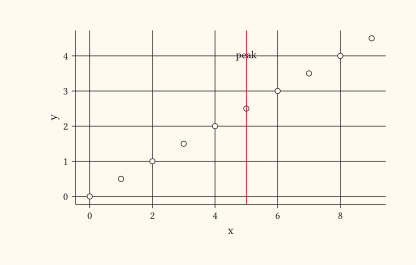
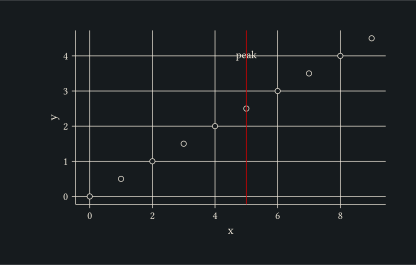
Inline text plus a vertical reference line at the same x.
#let d = range(0, 10).map(i => (x: i, y: i * 0.5))
#plot(
  data: d,
  mapping: aes(x: "x", y: "y"),
  layers: (
    geom-point(size: 2pt),
    annotate("text", x: 5, y: 4, label: "peak"),
    annotate("vline", xintercept: 5, colour: rgb("#cc0000")),
  ),
  width: 10cm,
  height: 6cm,
)
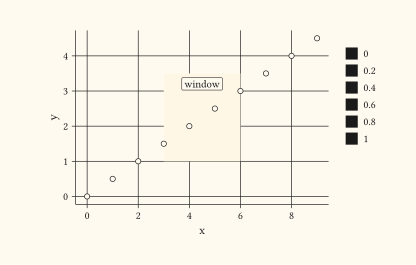
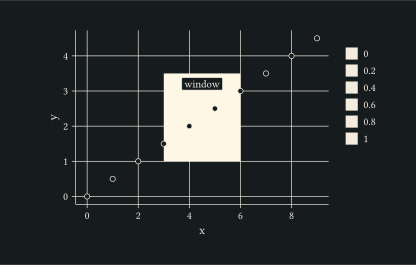
Highlight a region with a translucent rectangle and a boxed label callout.
#let d = range(0, 10).map(i => (x: i, y: i * 0.5))
#plot(
  data: d,
  mapping: aes(x: "x", y: "y"),
  layers: (
    annotate(
      "rect",
      xmin: 3, xmax: 6, ymin: 1, ymax: 3.5,
      fill: rgb("#fff7e6"), alpha: 0.5,
    ),
    geom-point(size: 2pt),
    annotate("label", x: 4.5, y: 3.2, label: "window"),
  ),
  width: 10cm,
  height: 6cm,
)
See also
aes, geom-text, geom-point, geom-label, geom-segment, geom-rect, geom-vline, geom-hline, geom-abline.