scale-x-time
Continuous x scale that formats axis labels as times of day.
Column values may be numeric seconds since midnight (an integer in [0, 86400)) or ISO-8601 strings of the form HH:MM[:SS]. Each break is converted via datetime(year: 2000, month: 1, day: 1, hour: 0, minute: 0, second: 0) + duration(seconds: int(n)) and rendered with dt.display(date-format); only the time portion of the pattern should be used.
Usage
scale-x-time(
  name: none,
  limits: none,
  oob: "drop",
  breaks: auto,
  labels: auto,
  expand: auto,
  date-format: "[hour]:[minute]",
)
Parameters
| Parameter | Default | Description |
|---|---|---|
name |
none |
Axis title. Overrides any name set via labels when both are present. |
limits |
none |
Pair (lo, hi) clipping the trained domain (numeric seconds since the epoch or ISO-8601 strings; either side may be auto), or none for automatic limits. |
oob |
"drop" |
Out-of-range policy: "drop" (default) removes rows whose value falls outside limits; "squish" clamps continuous values to the nearest endpoint. |
breaks |
auto |
Array of break values (numeric seconds since the epoch or ISO-8601 strings), or auto for automatic tick selection. |
labels |
auto |
Array of tick labels aligned with breaks, or auto. |
expand |
auto |
Padding around the domain. Accepts a ratio (5%) for proportional breathing room, a length (5pt) for canvas-space padding, a relative (5pt + 5%) for both, or a (lo, hi) 2-tuple for asymmetric padding, where either element may be auto to keep the per-scale default on that side. auto keeps the per-scale default; false collapses to zero. |
date-format |
"[hour]:[minute]" |
Typst datetime.display pattern used for break labels. |
Returns
Scale object consumed by plot.
Examples
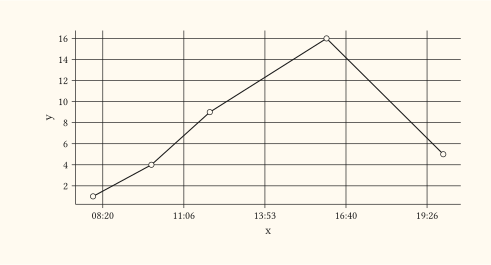
Time-of-day axis using ISO-8601 HH:MM strings.
#let d = (
  (x: "08:00", y: 1),
  (x: "10:00", y: 4),
  (x: "12:00", y: 9),
  (x: "16:00", y: 16),
  (x: "20:00", y: 5),
)
#plot(
  data: d,
  mapping: aes(x: "x", y: "y"),
  layers: (geom-line(), geom-point(size: 2pt)),
  scales: (scale-x-time(),),
  width: 12cm,
  height: 6cm,
)